

WASHINGTON – WASHINGTON — Defense Secretary Pete Hegseth ordered the U.S. military on Sept. 2 to kill all 11 people on a suspected drug-smuggling boat in the Caribbean Sea because they were on an internal list of narco terrorists who U.S. intelligence and military officials determined could be lethally targeted, the commander overseeing the operation told lawmakers in briefings this past week, according to two U.S. officials and one person familiar with the congressional briefings.
Such a list includes individuals who are eligible for being targeted, including with lethal action, if given the opportunity. The commander who oversaw the Sept. 2 strikes, Adm. Frank “Mitch” Bradley, told lawmakers that U.S. intelligence officials had confirmed the identities of the 11 people on the boat and validated them as legitimate targets, then the military launched airstrikes as part of President Donald Trump’s military campaign against alleged drug-smuggling vessels, the U.S. officials and person familiar with the congressional briefings said.
The detail that the 11 people on the boat were on an internal U.S. military target list has not previously been made public. It adds another dimension to the Sept. 2 operation that has been mired in controversy over the military’s decision to launch a second strike after the first left two survivors in the water.
Lawmakers have raised questions about whether the second strike violated international law. Whether Hegseth directed Bradley, who is the commander of U.S. Special Operations Command, to kill everyone on the boat has been key question in the controversy over the second strike.
An administration official said Bradley made clear in his briefings with lawmakers that he acted in complete compliance with the law throughout the operation. “As with all such actions, a uniformed JAG provided advice and counsel every step of the way,” the official said in a written statement, adding that the boat was targeted because it was “carrying cocaine” and was “affiliated with a cartel designated by the president as a terrorist organization.”
“The cumulative impact of these narcoterrorist shipments directly threaten Americans and the national security interests of the United States,” the official said.
The Pentagon did not respond to a request for comment. U.S. Special Operations Command declined to comment.
The Pentagon has said 22 strikes on alleged drug boats have killed 86 people — 11 strikes have been in the Caribbean Sea and 11 in the Eastern Pacific. The administration has produced no evidence supporting its allegations about the vessels or the people on board.
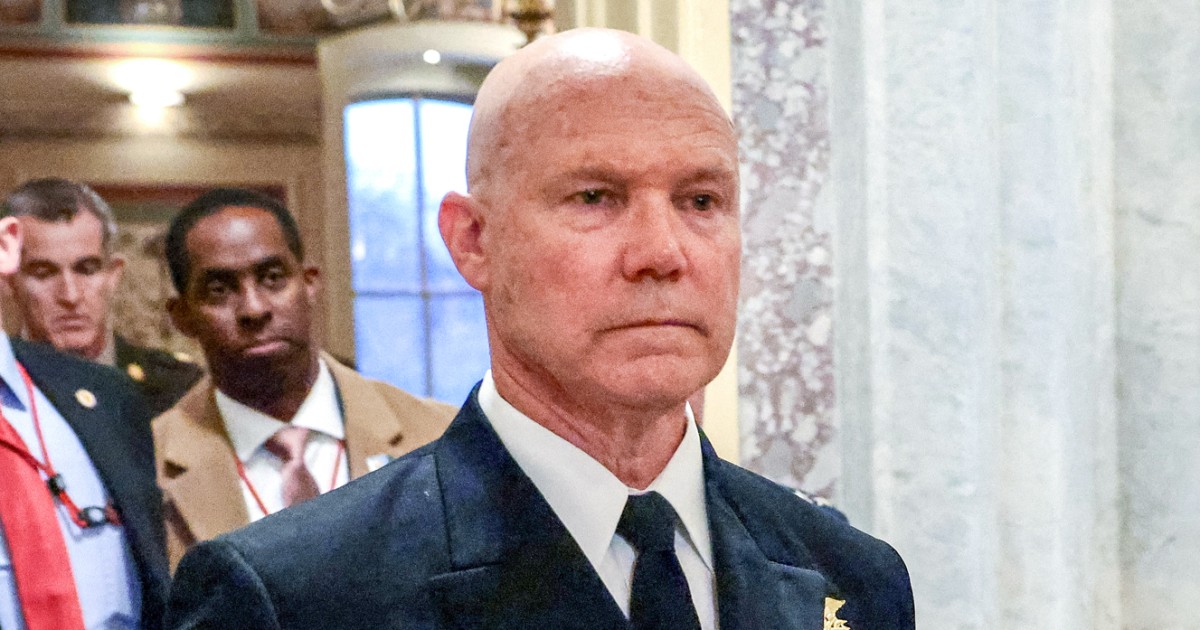
On Thursday, Bradley spent more than eight hours on Capitol Hill briefing a dozen members of Congress and their staff about what happened during the operation. The Chairman of the Joint Chiefs of Staff Gen. Dan Caine also attended the briefings.
This account of Bradley’s detailed timeline and explanation of events throughout the Sept. 2 operation as told to lawmakers in the private briefings is based on interviews with the two U.S. officials and person familiar with the congressional briefings.
Bradley told lawmakers that the orders he received from Hegseth were to kill the individuals on the approved target list, which included everyone on the boat, then destroy the drugs and sink the boat, those sources said.
White House press secretary Karoline Leavitt told reporters on Monday that “Secretary Hegseth authorized Admiral Bradley to conduct these kinetic strikes.” She added Bradley “worked well within his authority and the law directing the engagement to ensure the boat was destroyed and the threat to the United States of America was eliminated.”
Bradley told lawmakers the second strike killed the two survivors, but did not sink the boat, so he ordered a third and a fourth strike to complete the mission, the officials and person familiar with the congressional briefings said.
Hegseth has said he observed the operation on Sept. 2 but “did not personally see survivors.” During a Cabinet meeting at the White House this past week, he defended the second strike, saying Bradley “made the right call.”
“This is called the fog of war,” Hegseth said.
During Bradley’s joint briefing Thursday with the House and Senate Armed Services Committee leadership, he was pressed about whether Hegseth gave an order to kill everybody on board, according to one of the U.S. officials and the person familiar with the briefing. Bradley, referencing the approved list of targets, said Hegseth told him to kill everyone on board and to destroy the vessel, the official and person familiar with the briefing said.
In another briefing, Bradley was asked whether Hegseth gave him a ‘no quarter order,’ which is an illegal military directive to kill all enemy combatants and show no mercy, even if they surrender or are gravely injured, one of the U.S. officials and a second person with knowledge of the briefing said. They said Bradley replied that he was not given such an order and would not have followed one if it had been given. The White House and Hegseth have said no illegal orders were given.
Unlike a ‘no quarter order’, an order to kill everyone on a target list is not forbidden under U.S. and international law.
The three sources said Bradley said the military struck the boat with a GBU-69, a precision-guided munition that was set to air burst, meaning it detonated in mid-air rather than on impact. He said the explosion killed nine of the people on board, capsized the boat and damaged the back of it, including the motor.
Another part of the boat split off and caught fire, but a major section of the boat was not ablaze. The damage made the boat unlikely to continue navigating, Bradley told lawmakers.
For more than 30 minutes, Bradley said he observed the two survivors among the wreckage.
He told lawmakers there were bags of cocaine on the boat that were not ejected during the initial explosion. Because the bags of cocaine were not seen floating in the water, Bradley said he believed they were strapped in and had stayed tied down during the explosion, making it likely the drugs were still under the capsized boat.
The cocaine was wrapped in plastic waterproof bundles, which likely made them more buoyant and may have contributed to the boat not sinking, he told lawmakers.
The two survivors got on the side of the boat that was not on fire and were able to flip it over and eventually stand on it.
Bradley observed them take off their shirts to check each other for wounds and told lawmakers they did not appear to have any visible injuries. He said the military’s overhead surveillance zoomed in to ensure the survivors weren’t injured or bleeding.
A U.S. military aircraft overhead spotted the survivors waving their arms but could not say with certainty whether they were signaling to the aircraft, Bradley told lawmakers, according to the three sources.
He said he determined that while the boat sustained damage significant enough that it may not be able to navigate, it may still have been able to keep floating or drifting.
U.S. intelligence also spotted another larger boat in the area, determining that the damaged boat was supposed to link up with it to transfer the drugs onto the larger vessel.
The larger boat was not on the approved target list Bradley had, so he did not have the authority strike it. He said because the U.S. did not have positive identification of who was on the larger boat, waiting to see if it came to try to salvage the damaged boat and two survivors was not a viable option.
Bradley explained, the three sources said, that his decision to target the boat with the survivors was because the drugs were not destroyed and the individuals on the boat had not surrendered and were not visibly injured but were still on the list of approved targets. And while the survivors were not armed, he said the mission identified the drugs as the threat to the U.S., effectively deeming the cocaine as the weapon that could endanger Americans.
Even so, Bradley acknowledged to lawmakers that U.S. intelligence did not conclude the drugs were heading to the U.S. Rather it showed that the boat was traveling south toward another country in South America, Suriname, which was first reported by CNN. Bradley told the lawmakers the boat was eventually to Europe or Africa.



