

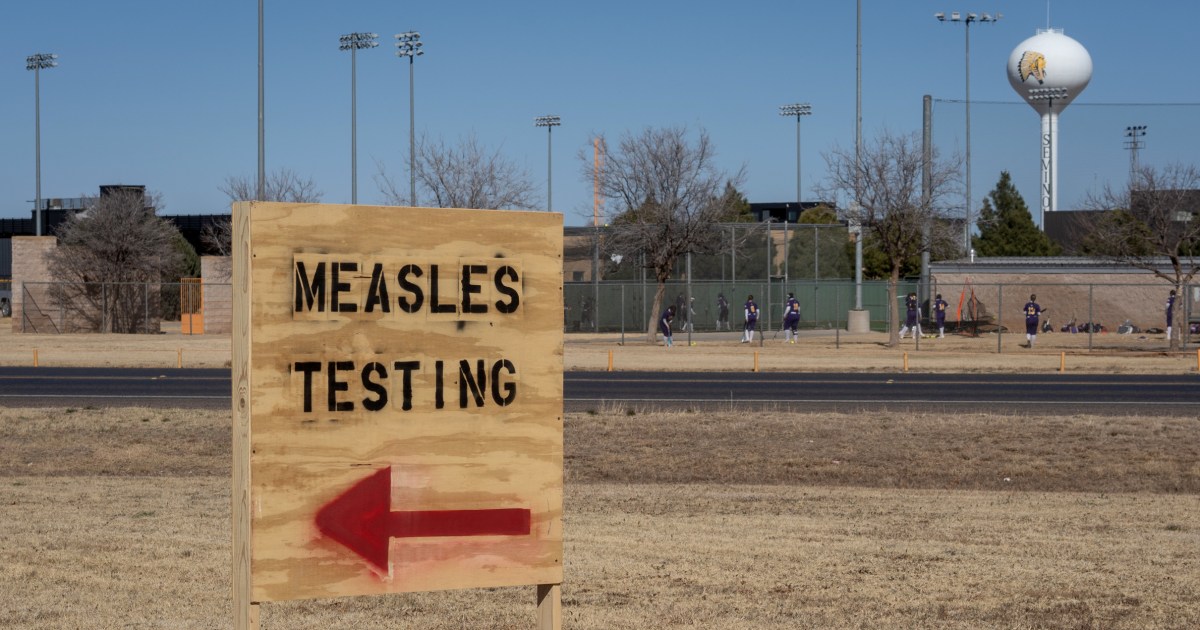
A year after the start of a deadly measles outbreak in West Texas, the virus continues to spread in several parts of the U.S. — a milestone both troubling and significant, as it could mean that measles is no longer considered eliminated in the country.
Measles has been eliminated in the U.S. since 2000, a designation that indicates the virus is no longer constantly circulating, though there are occasional outbreaks. However, global public health authorities consider the virus endemic — or always present — after one year of continuous transmission.
“We have all the ingredients to have our elimination status revoked,” said Amira Albert Roess, a professor of global health and epidemiology at George Mason University.
“In previous times, it would be unheard of to lose your elimination status, unless it was a war-torn, collapsing country,” she added.
The U.S. saw more measles cases in 2025 than in any year since 1991. The Centers for Disease Control and Prevention recorded 49 outbreaks and 2,242 cases last year. Another 171 cases have been confirmed this month — though the actual tally is likely much higher, since the CDC’s data lags behind that of state health departments.
Currently, South Carolina is the epicenter of the country’s measles problem: 646 cases have been recorded since October, according to the state health department.

A group within the World Health Organization, the Pan American Health Organization (PAHO), will ultimately determine whether the U.S. has lost its elimination status. That decision isn’t expected until November, said Noel Brewer, a professor of public health at the University of North Carolina at Chapel Hill. He chairs a committee of independent experts that will present an analysis of the U.S. measles response to PAHO ahead of the decision.
“2025 was the year of measles,” Brewer said. “We had more measles than we’ve had in the last quarter century. What will 2026 be remembered as? The year when things got much worse, or was the year when everything calmed down?”
Despite the continued uptick in measles cases over the last year, Brewer said the U.S. will not automatically lose its elimination status, since, technically, the same strain has to spread for at least a year for the designation to be revoked.
“As a formal matter, the U.S. does not seem destined to lose its elimination status in 2026 in terms of the PAHO definition,” he said.
Acting CDC Director Jim O’Neill said in November that, based on a preliminary analysis, a measles outbreak in Utah and Arizona that began in August was not directly linked to the one in Texas — which started in a rural Mennonite community with low vaccination coverage and led to 762 cases.
Two unvaccinated children died of measles during the Texas outbreak, which also stretched into New Mexico, where an unvaccinated adult died in March.
“The CDC will take a very careful look at this to try and determine whether it is sustained transmission,” said Dr. Walter Orenstein, professor emeritus at Emory University School of Medicine and former director of the U.S. Immunization Program at the CDC.
But Dr. Demetre Daskalakis, who resigned last year as director of the CDC’s National Center for Immunization and Respiratory Diseases, said measles’ spread is already out of control in the U.S.
“I’m going to say that elimination is already lost, frankly, no matter what any other body says, based on what we’re seeing domestically now,” Daskalakis said on a press call hosted by Public Health Watch, a nonprofit group that has been critical of Kennedy.
Canada lost its elimination status in November after recording more than 5,000 cases since October 2024.
Both globally and in the U.S., public health experts said, measles outbreaks last year were the result of declining vaccination rates. The virus is highly contagious — without immunity from a vaccine or prior infection, about 9 in 10 people exposed will get it.
Symptoms start with a high fever, cough and runny nose before progressing to red, watery eyes, white spots inside the mouth and a telltale splotchy rash. In rare cases, the virus can cause pneumonia, brain inflammation and other life-threatening complications.
For the past 25 years, the U.S.’ measles vaccination rates have been high enough to limit widespread transmission. But vaccination coverage has dropped below 95% in many states — the target threshold for curbing the spread.
In the 2024-2025 school year, 39 states had measles vaccination rates below 95%, according to KFF, a nonprofit health think tank. Before the Covid pandemic, just 28 states had rates below 95%.
A study published last week in the journal JAMA found that most U.S. counties are seeing a steady rise in vaccine exemptions for religious or personal beliefs among children entering kindergarten. The findings were based on a data investigation by NBC News, in partnership with Stanford University.
Under Health Secretary Robert F. Kennedy Jr., federal health agencies have framed vaccination as a personal choice.
“It doesn’t seem like there’s an appetite with this administration to really push hard on the primary way we can prevent this, which is vaccination,” said a CDC official who was not authorized to speak publicly but had direct knowledge of the agency’s measles response.
Though Kennedy has called for people to get measles shots, he has also emphasized unproven treatments such as steroids and antibiotics and falsely claimed that immunity from measles vaccines wanes quickly. (Two doses are 97% effective and usually offer lifelong protection.)
“A lot of us are sort of like — we kind of deserve to lose our elimination status because everything we’re doing is unraveling it,” Roess said.



