

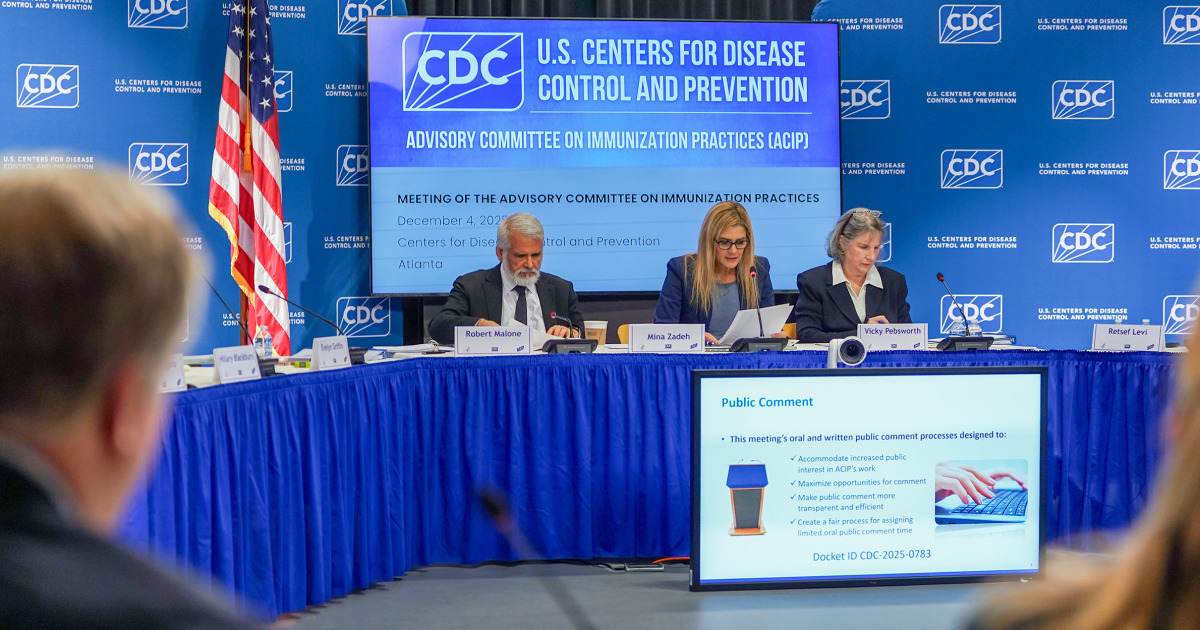
In a chaotic meeting Thursday rife with misinformation, the CDC’s vaccine advisory panel — whose members Health Secretary Robert F. Kennedy Jr. fired in June and replaced with a group that has largely expressed skepticism of vaccines — once again delayed an expected vote on hepatitis B vaccines.
Because of disagreements and confusion over the voting language, the Centers for Disease Control and Prevention’s panel, formally known as the Advisory Committee on Immunization Practices, decided to push the vote to Friday morning instead of holding it Thursday afternoon as scheduled. The committee had previously tabled a September vote on the hepatitis B vaccine schedule.
The meeting was, in numerous ways, a radical departure from past practices. Typically, the ACIP evaluates new vaccines or new indications for them, not shots that have been administered in the same way for decades.
The CDC has for 34 years recommended that all newborns get a first dose of the hepatitis B vaccine within 24 hours of birth. But the panel is considering whether to roll back that guidance and instead suggest that women who test negative for hepatitis B decide in consultation with a health care provider whether their baby should get the dose at birth.
If adopted, that recommendation would go against widespread consensus among public health experts, who before the meeting issued loud pleas not to change the hepatitis B vaccination schedule.
On Thursday, the advisory panel convened in the CDC’s broadcast studio, under bright lights and in front of large television cameras, instead of its typical conference room — giving the appearance of a televised show rather than a scientific discussion. When asked about the new venue, Andrew Nixon, a spokesperson for the Department of Health and Human Services, said it was meant to “accommodate increased public interest in the committee.”
The unruly proceedings featured a barrage of misleading claims and cherry-picked data.
Several presenters and panel members claimed there was limited evidence of the hepatitis B vaccine’s safety or efficacy, ignoring decades of evidence to the contrary. At past meetings, the CDC’s medical experts have presented data on the risks of a given disease and the safety and efficacy of vaccines that target it. But the presentations Thursday were instead given by two anti-vaccine activists and a climate scientist who has written for an anti-vaccine publication.
The meeting was the most blatant example to date of how far the panel has strayed from its original mission to consider who should get vaccines — and when — based on a complete scientific analysis of the risks and benefits.
In a presentation on safety, anti-vaccine activist Mark Blaxill — who was recently hired at the CDC — suggested that symptoms identified in babies who got the hepatitis B vaccine, such as fatigue, weakness, diarrhea or irritability were “possibly connected” to swelling of the brain, or encephalitis.
Dr. Cody Meissner, the only ACIP member who has previously served on the committee, pushed back: “That is absolutely not encephalitis,” he said. “That’s not a statement that a physician would make. They are not related to encephalitis, and you can’t say that.”
By early afternoon, multiple members of the committee expressed confusion over what they were voting on and pointed to issues with the voting language.
“Perhaps this was written by the department of redundancy department,” quipped ACIP member Dr. Joseph Hibbeln, a psychiatrist and neuroscientist.
The panel’s chair, Dr. Kirk Milhoan, was not present for the decision to postpone the hepatitis B vote. Vice chair Dr. Robert Malone said Milhoan was “about to jump on a plane to go to Asia and would not be available, I believe, for [the discussion] tomorrow.”

Dr. Jason Goldman, president of the American College of Physicians, commented during the meeting that the proceedings amounted to “political theater.”
“You are wasting taxpayer dollars by not having scientific, rigorous discussion on issues that truly matter,” Goldman said. “The best thing you can do is adjourn the meeting and discuss vaccine issues that actually need to be taken up.”
Sen. Bill Cassidy, R-La., said on X before the meeting began that the advisory panel is “totally discredited” and “not protecting children.” Cassidy, a liver doctor who treated patients with hepatitis B, chairs the Senate’s health committee and cast a key vote in favor of confirming Kennedy as health secretary.
Hepatitis B is an incurable infection that can lead to liver disease, cancer and death. The virus can be transmitted from mother to child during delivery, and not all pregnant women get tested for it. So public health experts say that delaying the shots could lead to more infections.
The prevailing medical consensus is that hepatitis B vaccines are overwhelmingly safe, based on decades of real-world data. A CDC analysis of children born from 1994 to 2023 estimated that hepatitis B vaccination prevented more than 6 million infections and nearly 1 million hospitalizations.
In addition to its vote on hepatitis B vaccines Friday, the CDC advisory panel is also expected to discuss the entire childhood immunization schedule, as well as the presence of aluminum salts found in many childhood vaccines, which help boost the immune response and reduce the number of required doses.
Both are hot-button topics among anti-vaccine activists, who often argue that children receive too many vaccines and that aluminum salts in them increases the risk of autoimmune conditions or neurodevelopmental disorders. Neither claim is supported by scientific evidence.
Aaron Siri, an anti-vaccine lawyer who has represented Kennedy, is expected to give a presentation Friday. Siri has advocated for the Food and Drug Administration to revoke its approval of the polio vaccine. It was his presence on the ACIP agenda that provoked Cassidy’s ire.
In response to Cassidy’s post on X, which singled Siri out, Siri fired back in his own post, challenging Cassidy to a long-form debate.
Aria Bendix reported from New York City, and Erika Edwards reported from CDC Headquarters in Atlanta.



