

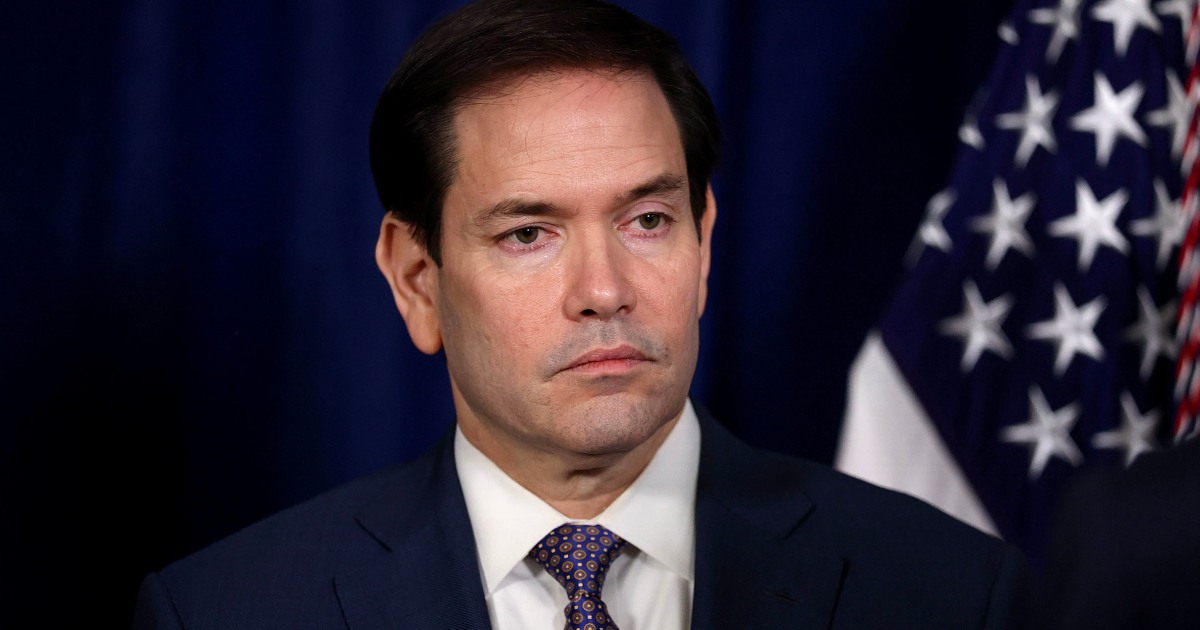
President Donald Trump ordered the military operation in Venezuela to capture Nicolas Maduro. But in the aftermath, Marco Rubio is in the spotlight.
Tasked with overseeing the transition of a post-Maduro Venezuela, Rubio has stepped into his fourth — and potentially riskiest — Trump administration role, and the coming weeks and months could define his standing as one of the president’s top advisers. A fixation for Rubio for more than a decade, Venezuela has now become a high-stakes gambit for Trump that could shape his own legacy.
And at a news conference with Trump following the stunning capture of Maduro and his wife, an emboldened Rubio put other world leaders on notice they could be next.
“Don’t play games while this president’s in office because it’s not gonna turn out well,” Rubio said.
As Maduro and his wife were making their first court appearance in New York on federal narcoterrorism and conspiracy charges on Monday, the challenges of a U.S.-led transition were coming into focus. Rubio was already softening the president’s pronouncements that the U.S. would “run” Venezuela for an unspecified period of time.
“It’s not running — it’s running policy, the policy with regards to this,” he said during an interview on NBC’s “Meet the Press,” contradicting Trump’s message. Rubio said the U.S. military forces that have been amassed near Venezuela would stay put for now, and a quarantine on sanctioned Venezuelan oil would remain to pressure the country’s new leader, Maduro’s vice president, Delcy Rodriguez, to fall in line.
Democrats, already seething over the administration’s decision to keep Congress in the dark on the Maduro operation, now question how far the administration will go.
“Where will this go next? Will the president deploy our troops to protect Iranian protesters? To enforce the fragile ceasefire in Gaza? To battle terrorists in Nigeria? To seize Greenland or the Panama Canal? To suppress Americans peacefully assembling to protest his policies?” said Democratic Sen. Tim Kaine of Virginia.
The 54-year-old former senator from Florida has been at the forefront of the increasingly aggressive and complex foreign policy of Trump’s second term. Trump first tapped him to serve as secretary of state, then added national archivist and interim national security adviser to his portfolio as the president has consolidated leadership positions across his administration.
It’s a remarkable trajectory for Rubio, said Republican strategist Matthew Bartlett, a former senior State Department official in the first Trump administration.
“Now he is not just influencing, but directing, leading just a remarkable engagement in our hemisphere, and potentially, remaking a new order, “ Bartlett said. “How that plays out will truly be not just the President’s legacy, but certainly Secretary Rubio’s legacy too.”
Rubio has had key roles in other major foreign policy initiatives, any one of which is a heavy lift — from Trump’s efforts to maintain a peace agreement between Israel and Hamas and end the war in Ukraine. But inside Trump’s inner circle, Rubio has owned Venezuela. For him, it’s personal: As a Cuban American senator in Florida, Rubio was focused on the abuses in Venezuela for 15 years, first under Hugo Chavez and now Maduro. The effort is popular in his home state, where many Venezuelans and similarly displaced Cuban Americans, including Rubio’s own parents, sought sanctuary from repressive regimes.
Cuban government television announced over the weekend that 32 Cuban combatants died in the U.S. military action against Venezuela. And Cuba, where the economy has been battered by a U.S. embargo, had been relying on sanctioned oil shipments from Maduro until the Trump administration’s quarantine.
Rubio framed Maduro’s arrest as a warning to the “incompetent senile men” running Cuba, saying “if I lived in Havana and I were in the government, I’d be concerned, at least a little bit.”
With Rubio at his side, Trump increasingly ramped up pressure on Venezuela, including a U.S. military campaign against alleged drug-smuggling boats that has roiled the Western Hemisphere and significantly escalated on Saturday with Maduro’s capture and removal to the U.S.
The policy is a significant escalation from Trump’s first term, when his administration increased and expanded sanctions on Venezuela. Trump publicly threatened to use military action if necessary and the U.S. officially recognized former opposition leader Juan Guaido as the legitimate president of Venezuela in 2019. But pressure stopped there.
“I think as Rubio persuaded him, he began to see that it was going to be potentially very important,” said John Bolton, who served as Trump’s national security adviser during the first administration and who is now one of his sharpest critics.
But if Rubio has shown Trump the potential value of a more aggressive response, he now has to deliver on what Trump wants. And his influence with the president — and position as the face of his Venezuela policy — could cut both ways.
“Rubio’s job is to accomplish something close to what the president says can be accomplished,” said Neumann, who served as ambassador to Afghanistan, Bahrain and Algeria during the George W. Bush administration.
“He’s between a rock and a hard place,” said Neumann.
Rubio’s positions have already seemed to shift. The U.S. is not turning to Venezuelan opposition leader Maria Corina Machado, who recently won the Nobel Peace Prize, or Edmundo Gonzalez, who greatly outpolled Maduro in the 2024 election that Maduro then stole. Last January, Rubio called Gonzalez Venezuela’s rightful president.
After meeting with exiled Venezuelan opposition figures last May, Rubio also called for the release of Maduro’s political prisoners and the restoration of democracy in Venezuela. Neither of those goals has been raised by Trump or Rubio since Saturday.
“Unfortunately, the vast majority of the opposition is no longer present inside of Venezuela,” Rubio said during Sunday’s “Meet the Press” interview.
He also said elections in Venezuela are “premature at this point” despite the country’s constitution calling for the vice president to succeed to the presidency and organize elections within 30 days.
The U.S. has not had a diplomatic presence in Venezuela since 2019. The State Department is making preparations for possibly reopening the U.S. embassy in Caracas if Trump decides to take that step, according to a senior State Department official.
American diplomats who focus on Venezuela currently are based in neighboring Colombia. More than half the countries in Latin America also currently do not have confirmed U.S. ambassadors. Those vacancies, coupled with the Trump administration’s cuts to the U.S. Agency for International Development and the U.S.’s chief international broadcaster Voice of America, leave Rubio with fewer regional allies and resources.
“The challenges he faces would in conventional times cause him to rely heavily on his senior staff at the State Department and counterparts at USAID and Voice of America,” said Douglas Lute, a retired Army general and former ambassador to NATO. “That just emphasizes the challenges he faces.”
Richard Fontaine, the chief executive officer of the Center for a New American Security, said Rubio’s dual-hatted roles as secretary of state and national security adviser complicate his ability to be the point person on a challenge as big as Venezuela.
“There’s a reason why you have not since Henry Kissinger has the role of National Security Advisor and Secretary of State been held by the same person,” Fontaine said. “There are only 24 hours in a day and you can only be in one place at the same time.”



