

Asked about the existence of any wreckage, Kremlin spokesman Dmitry Peskov called it “a matter for our military.” He labeled Zelenskyy’s dismissal of the attack and doubts raised in Western media “completely insane.”
Russia’s diplomatic position “will be toughened” as a consequence of the attack, Peskov said. “Our armed forces know how and when to respond,” he added.
Vyacheslav Volodin, the speaker of Russia’s lower house of Parliament, the Duma, also vowed that “there can be no forgiveness” for Zelenskyy. Frenzied coverage of the story has topped newscasts on state TV channels.
Putin has made no secret of his determination to press on with the war if a deal does not grant his hard-line demands.
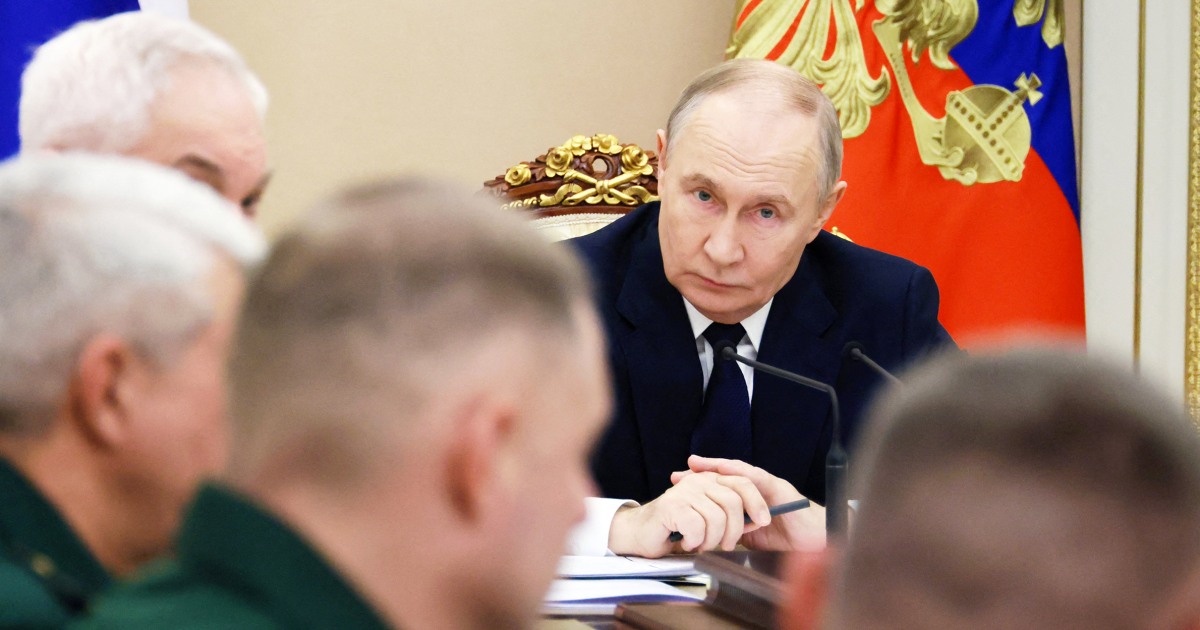
The Kremlin would not comment on the Russian leader’s whereabouts during the alleged attack. Hours earlier he appeared at his latest televised meeting with battlefield commanders, seemingly aimed at projecting to domestic and foreign audiences that Russia has the upper hand in the war and will take the territory it wants by force if it can’t get it at the negotiating table.
Zelenskyy has engaged in his own messaging campaign, and his meeting with Trump in Florida on Sunday was viewed as a success for Ukraine despite the lack of a clear breakthrough.
Russia’s sudden accusation should be seen as “perfectly timed theater,” said Matthew Ford, an associate professor in war studies at the Swedish Defence University in Stockholm.
Putin is trying to engineer “enough cover” for the Trump administration to enable him to press on with his hard-line demands while avoiding having the U.S. take Ukraine’s side, Ford said.
What does it mean for Ukraine?
Trump said he learned about the alleged attack directly from Putin and “was very angry about it.”
“I don’t like it,” Trump told reporters when asked if he was worried the alleged attack could affect his efforts to broker peace. Asked if there was any evidence of the attack, Trump said: “We’ll find out.”
Ukraine insists there is none.
“Almost a day passed and Russia still hasn’t provided any plausible evidence,” said Foreign Minister Andrii Sybiha. “And they won’t. Because there’s none. No such attack happened.”

Trump’s reaction hits a nerve at a particularly delicate moment for Ukraine.
Zelenskyy touted success Monday in obtaining long-term security guarantees from the U.S. that would be legally binding and help prevent a future Russian attack. Trump had offered Ukraine security guarantees for at least 15 years, he said, while Kyiv was asking for as much as 50 years.
But later, when he was asked whether American troops would be deployed in Ukraine, Zelenskyy told reporters on WhatsApp that it was for Trump to decide. “We would like this,” he said. “It would be a strong component of security guarantees.”
This is no abstract issue for Ukraine, whose cities are being bombarded near-daily by Russia, resulting in civilian deaths and damage even as negotiations continue.
Trump’s quickness in repeating Russia’s claims underlines that Kyiv needs to understand exactly what security guarantees it’s getting and how they would work, said Sviatoslav Yurash, a member of Ukraine’s Parliament and a serving soldier.
For Yurash and others, the Kremlin’s claim appeared little more than another “false-flag operation,” raising concerns that it could repeat the strategy in the future to violate a truce without being stopped by those enforcing any deal.
“We already had a declaration when we gave up the world’s third-biggest nuclear arsenal,” said Yurash, referring to the failure of the 1994 Budapest Memorandum, co-signed by the U.S., to protect his homeland from being invaded by Russia. “We need something more than a neatly written piece of paper,” Yurash added.
Phillips O’Brien, a professor of strategic studies at the University of St. Andrews in Scotland, agreed.
“The Ukrainians cannot trust the U.S. government’s treaty pledges at all,” he said. “They have already had those, and they were meaningless.”

Daryna Mayer and Reuters contributed.



