

WASHINGTON — The U.S. could have to pay as much as $700 billion if it were to achieve President Donald Trump’s goal of buying Greenland, according to three people familiar with the cost estimate.
The estimate was generated by scholars and former U.S. officials as part of planning around Trump’s aspiration to acquire the 800,000-square-mile island as a strategic buffer in the Arctic against America’s top adversaries, these people said. It attaches a price tag of more than half the Defense Department’s annual budget to Trump’s national security priority, which has stoked anxiety across Europe and on Capitol Hill amid his rhetoric about seizing Greenland since he ordered a U.S. military raid to capture Venezuela’s president and his wife.
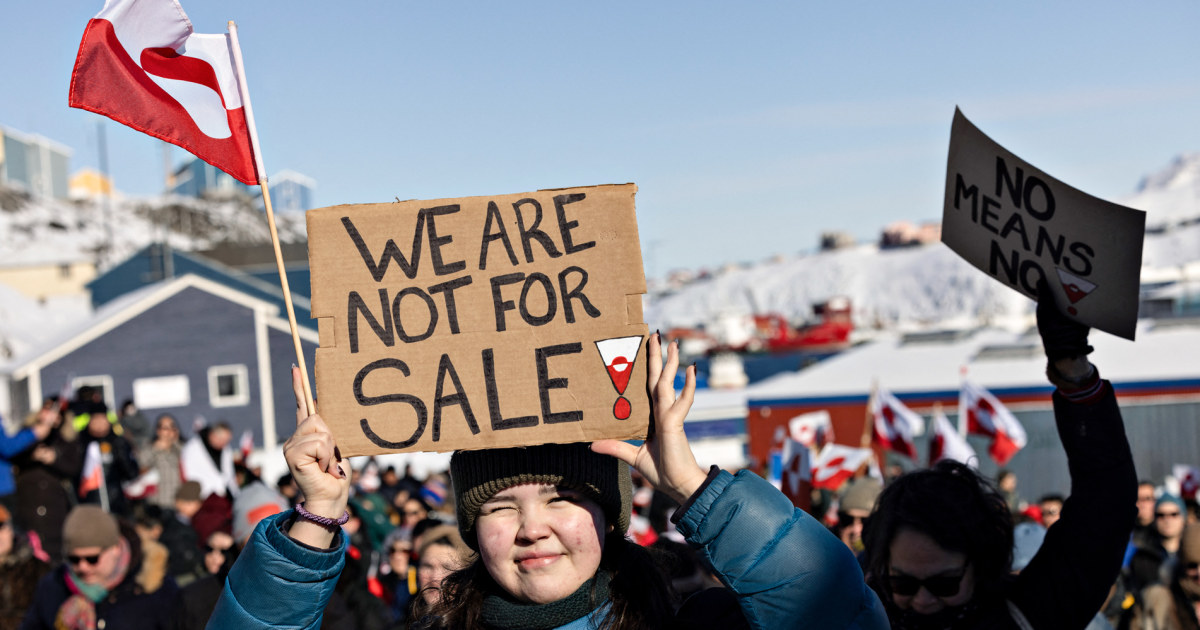
Greenland, the autonomous territory of the Kingdom of Denmark, is not for sale. Officials from Denmark and Greenland have rejected Trump’s claims that the U.S. will acquire Greenland “one way or the other.” A senior White House official, however, said Secretary of State Marco Rubio has been directed to come up with a proposal in the coming weeks to purchase Greenland, describing such a plan as a “high priority” for Trump.
On Wednesday, Rubio and Vice President JD Vance are scheduled to meet with officials from Denmark and Greenland, who traveled to Washington seeking a better understanding of Trump’s intentions and proposals. The meeting follows lower-level discussions last week between officials from Denmark and Greenland and the White House National Security Council.
“I’d love to make a deal with them,” Trump told reporters Sunday when he was asked whether there is a deal Greenland could offer. “It’s easier. But one way or the other, we’re going to have Greenland.”
In the hours before Wednesday’s meetings, the message from Greenland’s government was consistent.
“Greenland does not want to be owned by, governed by or part of the United States,” Foreign Minister Vivian Motzfeldt said as she arrived in Washington on Tuesday. “We choose the Greenland we know today — as part of the Kingdom of Denmark.”
Greenland’s minister for business and mineral resources, Naaja Nathanielsen, said Tuesday that the messages from the U.S. are causing such concern for Greenlanders that they are having trouble sleeping.
“This is really filling the agenda and the discussions around the households,” Nathanielsen said at a news conference in London. “So it’s a massive pressure that we are under, and people are feeling the effects of it.”
Despite the anxiety, Nathanielsen said, “we have no intentions of becoming American.”
The U.S. can already put more troops in Greenland and expand its military and security capabilities there under the current agreement between the two governments, said a U.S. official familiar with the issue.
“Why invade the cow when they’ll sell you the milk at relatively good prices?” the official said.
While some Trump administration officials have said the U.S. could use military force to take the island of 57,000 residents, some administration officials and outside White House allies view a U.S. attempt to purchase or form a new alliance with it as the likelier outcome.
Another option under consideration includes forming what is known as a compact of free association with Greenland, an agreement that would include U.S. financial assistance in exchange for allowing the U.S. to have security presence there, NBC News has reported. The U.S. has similar agreements with the Republic of the Marshall Islands, the Federated States of Micronesia and the Republic of Palau. Adding Greenland to the mix could satisfy part of Trump’s broader vision for American hegemony in the Western Hemisphere — and could be less costly than the purchase price estimate for Greenland of $500 billion to $700 billion.
The U.S. in 1916 agreed to buy islands in the Caribbean from Denmark and in turn acknowledged that the U.S. “will not object” to the Danish government’s holding political and economic interests to all of Greenland, according to the agreement at the time.
Trump has said he wants to acquire Greenland to have more rights to the land, comparing it to owning versus leasing a property. Ownership could make Greenland akin to a U.S. territory like Guam, American Samoa or Puerto Rico and solidify Washington’s strategic relationship with the island for the long term.
Trump’s desire to acquire Greenland stems in part from concerns that its residents could seek independence and that, if they are successful, the island’s 27,000 miles of coastline could fall into the hands of adversaries like Russia or China, according to some experts on the issue and congressional testimony from former U.S. officials.
Greenlanders reject the idea of becoming part of the U.S. by a large margin. An independent poll last year concluded that about 85% rejected the idea.
Trump, a former real estate magnate, has long had his sights on Greenland, saying the U.S. needs it for national security in the Arctic Circle and would look at acquiring it. When Trump expressed interest in buying the island during his first administration, the idea was not treated as a serious top priority, even by some of his closest aides.
That has dramatically changed in his second term, as his designs on Greenland are being taken far more seriously both inside his administration and among America’s allies. Trump began making public overtures soon after he took office last January. In December, he appointed Louisiana Gov. Jeff Landry as a special envoy to Greenland, reigniting concerns among Danish and Greenland officials.
Now there is a growing sense of inevitability in Europe and the U.S. that Trump will gain some ground in his Greenland aspirations as he seeks to expand American influence in the Western Hemisphere. The question is how — economic coercion, diplomacy, military force — and how much.
Trump’s threat to take over Greenland, including leaving the prospect of doing it through military force on the table, could be aimed at pressuring Greenland and Denmark to come to the table to talk about how the U.S. can be better positioned there, said Ian Lesser, a fellow with the German Marshall Fund of the United States, a nonpartisan think tank. “I still think the prospects of the use of force over this issue is still very small,” Lesser said.
“It’s unnecessary,” he added. “What would be the point? It would stir up unbelievable tensions within the NATO alliance and maybe even spell the end of the NATO alliance, and I don’t think the president would have support [from] Capitol Hill for any of that.”
Trump’s saber-rattling toward Greenland has met resistance on Capitol Hill, including among some Republican allies who lauded his administration’s military operation in Venezuela.
On Tuesday, a bipartisan duo of senators introduced legislation that would prohibit the Defense Department from using funds to assert control over the sovereign territory of a NATO member state without that state’s authorization or approval by the North Atlantic Council, NATO’s principal political decision-making body, a clear message of opposition to Trump’s rhetoric about acquiring Greenland.
Greenland, which Vance and his wife, Usha, visited last year, hosts a small U.S. military footprint at Pituffik Space Base. The base includes a contingent of U.S. Space Force and other military personnel who staff radar systems that serve as an early warning system for any attacks from Russia. The U.S. and Denmark also share intelligence regularly about what the military sees in the region.
Greenland has long been receptive to hosting more U.S. military assets or to negotiating over its strategic resources, which include rare-earth minerals.
“It is possible to find a way to ensure stronger footprints in Greenland” for the U.S. military, Danish Prime Minister Mette Frederiksen said last year. The U.S., Frederiksen said, is “already there, and they can have more possibilities.” Frederiksen more recently expressed concern that any effort by Trump to take Greenland by force would unravel NATO, because Denmark and the U.S. are both members.
And last week, America’s European allies, including Denmark, said in a joint statement that they would “not stop defending” the values of sovereignty and Greenland’s territorial integrity.
“Greenland belongs to its people,” they said.



