

This article is by F. Brinley Bruton reporting from Bogotá, Colombia, and a Caracas-based reporter who is not being identified because of safety concerns.
CARACAS — Political reality is settling in in Venezuela as the regime once led by deposed President Nicolás Maduro tightens its hold on the country.
Many Venezuelans opposed to Maduro’s rule were overjoyed when U.S. special forces captured him over the weekend, believing this would be quickly followed by a transition to a form of a new government. But for some, these hopes have dimmed in recent days.
No political prisoners appear to have been released, and the government is cracking down on any new signs of dissent, arresting people they said celebrated Maduro’s capture by the United States military. The country’s security and intelligence apparatus is out in force, with masked paramilitary “colectivos” — armed civilians who support the government — roaming the streets on motorcycles, and military intelligence agents in civilian clothes circulating in vans with an official insignia and setting up roadblocks. The entire top leadership remains intact, with the notable exception of Maduro himself.
The lack of change in government was underlined by a recent classified intelligence assessment that determined that top members of the Maduro regime — including former Vice President Delcy Rodriguez, sworn in as interim president on Monday — were best positioned to lead Venezuela’s government and maintain stability.
That assessment factored in President Donald Trump’s dismissal of Maria Corina Machado, the exiled opposition leader and Nobel Peace Prize winner, as the best person to take over running the country, sources told NBC News.
These developments were a gut-punch for Michelle, a resident of Caracas.
“For many years I wished for my country’s government to change, and I thought that when that day came I would feel very happy. But that’s not the case,” said the 34-year-old architect, who moved back to Venezuela last year. “Somehow we will have to pay: either with oil or with our own dignity and sovereignty.”
Michelle and others who spoke to NBC News in Venezuela asked not to be fully identified out of fear the government would punish them.
“A dangerous precedent is being created between the United States and Latin America,” Michelle said. “We realize that we are just another piece on the board in the struggle between powers, for whom the future of the Venezuelan people lacks relevance compared to the importance of valuable resources, which are worth more than life itself.”

Trump has repeatedly referred to his desire for Venezuela, which sits on the world’s largest oil reserves, to open its market to American companies. On Tuesday he said Venezuela would “be turning over” up to 50 million barrels of oil to the U.S., adding that the revenue from the oil will be used to benefit both Americans and Venezuelans.
But pessimism about recent events in Venezuela isn’t shared by all opposition supporters, including former political prisoner Luis Mata.
“It’s like eating a pizza — they go slice by slice. We have to trust the process,” the political activist and human rights defender living in exile, told NBC News. Confusion surrounds the fate of the 800 to 900 political prisoners who remain incarcerated after the presidential elections on July 28, 2024.
Mata, 26, was one of the thousands of volunteers who safeguarded vote tallies during the 2024 vote. The Maduro government overturned what independent election observers, rights groups and foreign governments said was a resounding opposition victory.
Days after the election, Mata was detained by police officers as he tried to leave the city where he lived after hearing the government was looking for people who safeguarded the votes. He was charged with seven crimes and spent four months imprisoned in Tocorón jail. He is now outside Venezuela.
“Many say the United States wants to seize the oil, but the United States is a trade ally. The United States supports freedom in Venezuela,” he said.
“For me, change is closer than ever. Nicolás is out of the country and will never set foot in Venezuela again,” added Mata, who asked that NBC News not reveal his location out of security reasons. “Freedom is about to arrive.”
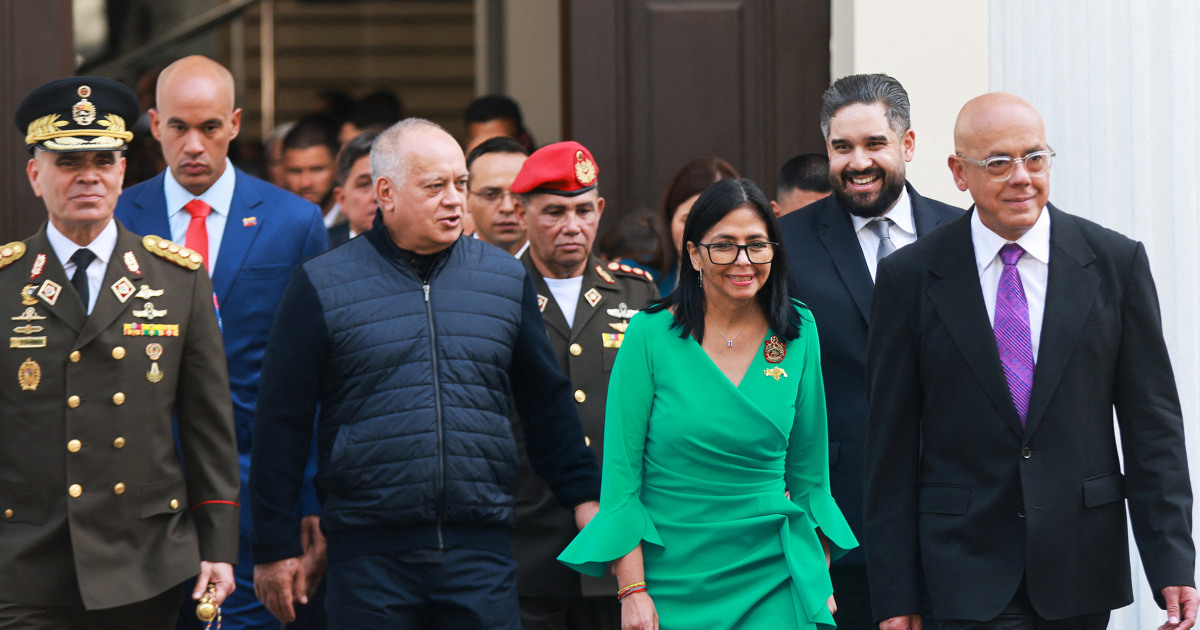
Whether or not “freedom” is about to sweep across Venezuela, the old regime is intent on projecting continuity. A striking symbol of this was when Delcy Rodriguez was sworn in as president and the country’s leadership marched shoulder-to-shoulder in front of the National Assembly on Monday.
In the photograph released by the presidential palace, Rodriguez is flanked on one side by her brother and the president of the National Assembly, Jorge Rodriguez. On her right is Diosdado Cabello, who as minister of the interior minister, justice and peace oversees police, counterintelligence forces and the “colectivos” that have struck fear among many Venezuelans. Also surrounding her are seen minister of defense Vladimir Padrino, in full formal military uniform, and a smiling Nicolás Maduro Guerra, the son of the ousted leader.
The image runs counter to repeated statements by Trump asserting that the U.S. is “in charge” in Venezuela.
“They’re going after anybody who potentially supported the U.S. mission to get Maduro,” James Story, the last U.S. ambassador to Venezuela, said at an event hosted by the Atlantic Council, a Washington-based think tank.
“They’re going to go round them up, and they’ve already rounded up some people. If they’re doing that, then we don’t run the country,” said Story, who served as ambassador from 2018 to 2023.
Marlenis, a domestic worker in Caracas, doesn’t seem too worried about Trump’s plans for Venezuela. She says that after 25 years of a system that has made her poorer every day, Venezuelans have nothing to lose by trying something different.
“What else can we lose?” she said, while waiting for the bus to go home after work. “If everything goes badly, people are already used to bad things.”



