

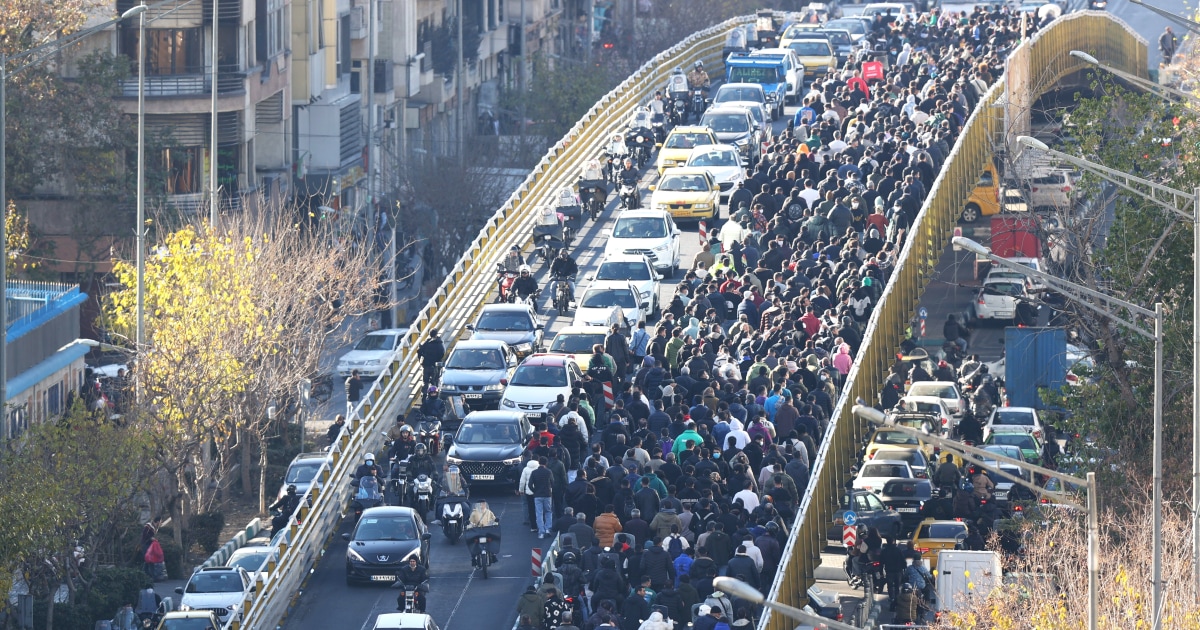
President Donald Trump vowed Friday to intervene if Iran shoots or violently kills peaceful demonstrators, as economic protests spread and evolved into deadly unrest.
If Iran “kills peaceful protesters, which is their custom, the United States of America will come to their rescue. We are locked and loaded and ready to go,” Trump said in an overnight post on Truth Social.
Senior Iranian officials fired back, warning that U.S. intervention would spark regional chaos and be met with a firm response.
It comes after protests in the Islamic Republic took a sharply violent turn in recent days, with at least seven deaths reported by a human rights organization and at least three reported by a semiofficial news agency.
The protests erupted Sunday in the capital Tehran, with crowds largely chanting about economic grievances after the country’s currency hit a record low against the dollar as prices soar.

People have since taken to the streets in smaller cities, and the protests have taken a more political bent with slogans targeting the clerical regime and Supreme Leader Ayatollah Ali Khamenei, the country’s highest authority.
Iran’s economy has been battered by years of sanctions and a 12-day war with Israel last June — when the U.S. military also attacked the country’s nuclear facilities — added to the sense of popular unease. A water crisis also led to taps running dry at times late last year.
Iran’s civilian government, led by President Masoud Pezeshkian, has been signaling it wants to negotiate with protesters and recognized their “legitimate demands.”
But responding to Trump, Ali Larijani, a former parliament speaker who serves as the secretary of Iran’s Supreme National Security Council, alleged without providing evidence that Israel and the U.S. were stoking the demonstrations.
“Trump should know that intervention by the U.S. in the domestic problem corresponds (to) chaos in the entire region and the destruction of the U.S. interests,” Larijani wrote on X, which the Iranian government blocks. Khamenei adviser Ali Shamkhani warned that “Any hand of intervention that comes close to Iran’s security under any pretext will be cut off before it can act.”
Fatalities were reported Thursday among both protesters and security forces.
Gunshots can be heard in several videos of protests that have been posted online since Wednesday. The semiofficial Fars news agency reported Thursday that three people were killed and 17 were injured in what they characterized as an attack on a police station in the city of Azna in Lorestan province in western Iran.
One video posted online and geolocated by NBC News which circulated on Thursday shows two cars on fire in front of a police station in Azna with a nearby crowd cheering as multiple gunshots ring out.
In a separate video posted online and geolocated by NBC News which circulated on Thursday, a large crowd in the city of Marvdasht in Fars province in southern Iran is seen walking toward a group of security forces while chanting, “shameless.”
The Hengaw Organization for Human Rights named three men it said were protesters killed in Azna, one man killed by security forces in Marvdasht, two men killed by security forces in Lordegan in Chaharmahal and Bakhtiari province in central Iran and one man killed by security forces in Fuladshahr in Isfahan province.
Hengaw also named Amirhesam Khodayari Fard as a protester who was killed by security forces in the city of Kuhdasht in Lorestan province in western Iran on Wednesday. The semiofficial Tasnim news agency said Khodayari Fard was a member of the Basij militia, which is overseen by the Islamic Revolutionary Guard Corps, who it said was killed in a clash with protestors.
NBC News could not independently determine which version of events is accurate.
The demonstrations appeared to be the largest in the Islamic Republic since the Woman, Life, Freedom protests in 2022 and 2023, which posed a serious challenge to authorities and only dwindled after a harsh crackdown from security forces that led to the death of some 500 people and the arrest of thousands.
“I think the regime is really cornered in the sense that it cannot address any of the grievances and yet it cannot tolerate people protesting,” Hadi Ghaemi, executive director of the Center for Human Rights in Iran, a New York-based advocacy group, told NBC News in a telephone interview.
“So violence has always been their only tool,” Ghaemi said.
The government appeared to take a step to quell this week’s unrest by declaring a public holiday on Wednesday, citing cold weather. This created a four-day break, including the traditional Iranian weekend and a religious holiday for the birthday of Imam Ali on Saturday.
Security forces will likely be out in large numbers on Saturday, which is also the anniversary of top commander Gen. Qassem Soleimani’s killing in a U.S. drone strike in 2020.
Trump threatened Iran with unspecified “consequences” after a meeting with Israeli Prime Minister Benjamin Netanyahu in Florida earlier this week. He said Iran “may be behaving badly” and suggested it was trying to rebuild nuclear sites after the U.S. struck three of them last year.
Pezeshkian said in a post on X that his country’s response to “any aggressive action would be harsh and regrettable.”



