

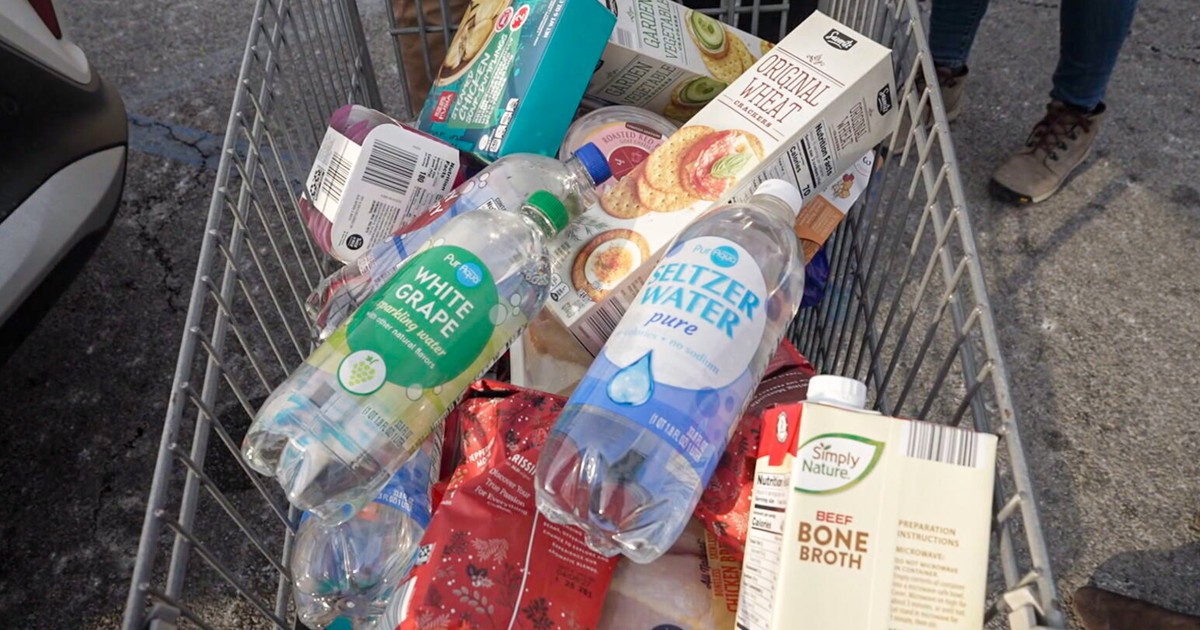
Newlyweds Brittany Zwier and Frank Martinez are starting their life together looking for ways to save money.
Zwier, 32, and Martinez, 40, have an annual income of more than $100,000 — but are finding their dollars aren’t stretching as far as they used to.
The couple now buys groceries exclusively at the no-frills supermarket chain Aldi, where they say the prices are cheaper than at other stores.
“We’re just buying what we need right now,” Zwier said outside an Aldi in New Jersey.
They have stopped buying beef, which hit record-high prices this year as climate and import issues limited cattle supply.
Zwier and Martinez are not alone. For millions of Americans, the cost of living has risen sharply in recent years, fueled by a mix of persistent inflation, high interest rates, soaring energy costs and consumer price increases due to tariffs.

More than half of respondents in a recent NBC News poll said they have changed the groceries they buy in order to stay within their budgets. In the same survey, the cost of housing and the cost of food ranked as the top two economic problems respondents said their families were facing.
This affordability crisis continues despite recent signs pointing to a resilient economy. The S&P 500 and Dow Jones stock indexes both closed at record highs on Christmas Eve. And newly released data showed that GDP grew 4.3% in the third quarter of the year, much more than economists had been expecting.
‘Falling behind’
The spoils of a booming stock market are not being distributed evenly. Economists say consumers are separating into two distinct tiers — what they’re calling a K-shaped economy.
“The K-shape economy means that some Americans, usually the wealthiest Americans, are doing just fine,” said Heather Long, chief economist at Navy Federal Credit Union. “They’re in the top of the K. Their incomes are rising. Their spending is rising.”

But many on the lower end of the “K” are finding their paychecks can’t keep up with rising costs of food, housing, utilities and child care.
“They feel like they’re falling behind, or, if on a good day, maybe treading water,” said Long.
To keep their expenses in check, Zwier and Martinez have cut back on eating out.
“Maybe once every three months now, we’ll go out,” said Martinez. “Used to be at least date night here and there. But that’s something we’re now sacrificing because everything is just too expensive.”
Zwier and Martinez are part of a broader pullback in restaurant spending — one that is taking a bite out of fast-casual spots like Chipotle, Cava and Sweetgreen.
“A lot of the chain restaurants have had a hard time in this environment where people don’t want to pay $15 to $20 for a burrito or a salad,” said Long.
The K-shaped shift has also drawn the attention of Federal Reserve Chair Jerome Powell.
“We’re seeing people tightening their belts, changing products that they buy, buying less,” Powell said at a recent press conference in Washington.
And the price pinch many consumers are experiencing this year goes beyond food.
Zwier and Martinez have seen their electric and gas bills skyrocket. “We’re using less, and it costs more,” Zwier said.
Across the country, electricity costs have jumped 6.9% in the last year, more than twice the rate of inflation, according to the Bureau of Labor Statistics.
This winter, U.S. households could spend an average of $995 on home heating alone, an increase of $84 from 2024, according to the National Energy Assistance Directors Association.
“These increases may not sound dramatic to higher-income households,” said Mark Wolfe, executive director of NEADA. “But for families already struggling, they are devastating.”
Budget boom
Budget retailers and grocers like Costco, Walmart and Aldi are well positioned to benefit from shifting spending habits among higher- and middle-income consumers.
“We’re seeing shoppers across all demographics and income levels turning to Aldi, because the simple truth is that no one wants to pay more for groceries than they have to,” an Aldi spokesperson said in a statement to NBC News.
Aldi has seen explosive growth over the last decade. The grocer said it operated 1,230 U.S. stores in 2012. That number had nearly doubled to around 2,400 U.S. stores in 2023. And Aldi plans to expand further with 800 new stores nationwide by 2028.
The discount supermarket chain has gained a reputation for low prices and a bare-bones approach. Coin-operated shopping carts, few name-brand products and items shelved in cardboard containers and crates are all part of the Aldi experience.
The promise of low prices draws shoppers like Michael Torres, who said he has been coming to Aldi for the last couple years. Torres and his wife, who have a 1-month-old daughter, are finding ways to make ends meet on an income of less than $50,000 a year.

“As much as you can save is important,” Torres said outside a New Jersey Aldi earlier this month. “You still want to make sure you have the fridge full, whatever you need on the table.”
“There’s wants and there’s needs,” he added. “If you need something, you get it.” But for now, he said, some “wants” may have to wait.
Two tiers
As many Americans pull back on spending, the U.S. economy has become increasingly dependent on high-income households.
The top 10% of earners were responsible for a record 49.2% of total U.S. consumer spending in the second quarter of this year, according to Moody’s Analytics.
Many businesses are seeing strong demand for their premium fare. Ford and General Motors recently reported soaring sales for their biggest and priciest SUVs.
Some companies are also building out their higher-end offerings to draw in big spenders.

This month, American Airlines debuted a splashy new plane with lie-flat seats and Bluetooth connectivity while budget carrier JetBlue just opened its first airport lounge.
But economists warn that relying on a tiny slice of Americans to drive consumer spending could put the U.S. on shaky footing. Consumer spending makes up the lion’s share of the nation’s total economic activity.
“Whether the economy goes into a recession in 2026 hinges almost entirely on the top 20%,” said Navy Federal Credit Union’s Long. “If they do well, the overall economy does well. If they don’t, then we’re looking at a recession.”
In the meantime, she said, everyone else could face growing pressure.
“Wage gains are going to keep getting smaller, and inflation, those basic costs, are going to keep ticking up,” said Long.
“That’s a recipe for middle-class squeeze.”



