

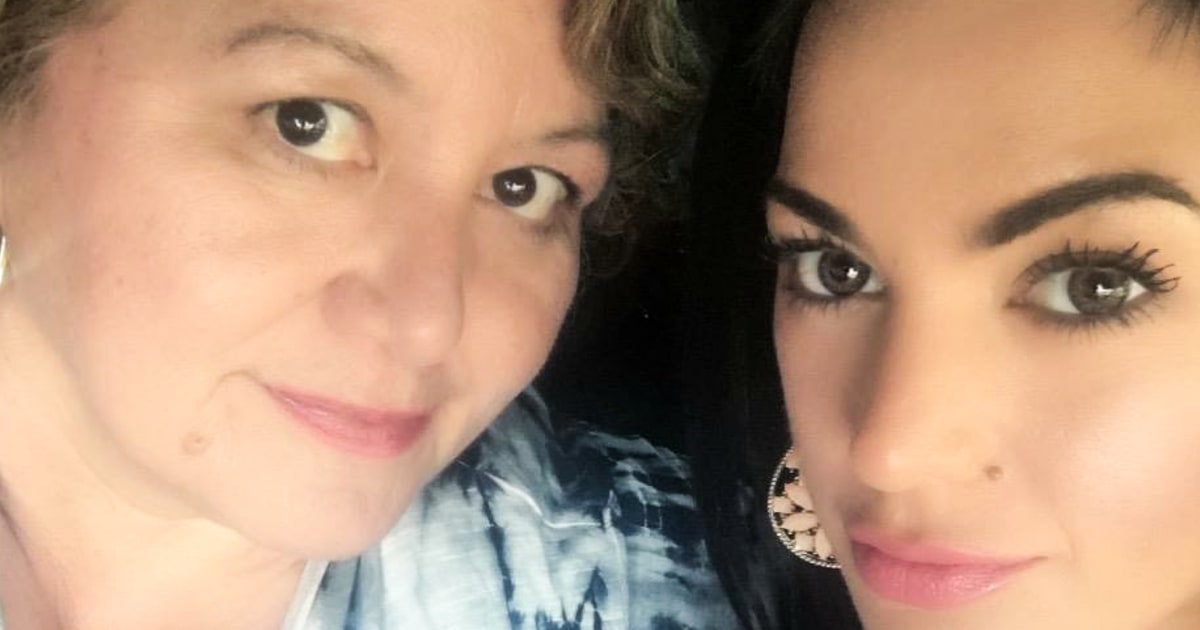
She’d waited years for the news.
But when the message arrived Aug. 26, 2022, Josephine Wentzel suddenly had to confront an agonizing possibility. She’d spent six years tracking the man authorities believed was responsible for killing her daughter, a search that spanned thousands of miles, international borders and dozens of possible sightings that, in the end, had produced little.
Wentzel declined to identify the message’s sender, but she said it supposedly contained a recent picture of Raymond McLeod, who at the time was one of the U.S. Marshals Service’s most wanted fugitives. Had he actually been found — or would this be another jolt of false hope?
She focused in on the image, she said, and “just freaked out like, oh, my gosh, it’s him. I didn’t even want to think it because someone might hear my thoughts and warn him to flee.”
McLeod, a 42-year-old former U.S. Marine, was apprehended in El Salvador days later and is awaiting trial in San Diego on a charge of first-degree murder in the June 2016 strangulation of Krystal Mitchell. He pleaded not guilty and is scheduled for a preliminary hearing in March. His attorneys either declined to comment or did not respond to a request for comment. In court filings, they said McLeod accidentally killed Mitchell during “rough, consensual sex gone wrong.”
Wentzel, a 67-year-old grandmother and former police detective had been preparing for life as an RV’ing snowbird when her daughter was killed. She has used the improbable platform she developed pursuing McLeod to write two books — “The Chase” and “The Capture” — and to help other grieving parents navigate the mix of frustration, despair and confusion left by an unsolved homicide.
Wentzel has assisted a nonprofit that helps law enforcement agencies with a series of cases in recent years, including the disappearance and alleged murder of Maya Millete, according to the Cold Case Foundation’s co-executive director. Through a nonprofit Wentzel established, Angels of Justice, she launched a campaign urging the White House to treat the country’s massive backlog of unsolved murders as a national emergency.
In a statement, a White House spokeswoman blamed former President Joe Biden for failing to enable law enforcement agencies to “truly fight crime” and said that President Donald Trump is “restoring integrity to our justice system.”
A spokesperson for the Marshals Service, which apprehended McLeod, declined to comment on questions about Wentzel’s role in finding him, but in a statement after McLeod’s capture the agency’s director said Wentzel had worked “diligently with law enforcement these past years to see this day of justice arrive.”
The San Diego County District Attorney’s Office has said she was “instrumental” in the search for McLeod.
“She goes for it,” said Pat Kuiper, who credits Wentzel with helping push investigators in Washington state to take another look at the nearly two-decade-old unsolved murder of her son. “She goes for it in such a way that people can’t really refuse her, because she’s so genuine and kind, but persistent, assertive.”
For Rachel Glass, whose daughter was found strangled along with her pregnant roommate in Arizona 15 years ago, Wentzel provided an empathetic ear and insight into an investigative process that Glass — a longtime nurse — knew nothing about.
“If there are things that go on and you think, what the hell is this, I’d call her and say, you won’t believe what’s happened now,” Glass recalled. “And she might tell me x, y and z about why it has to play out like that.”
Wentzel’s husband of nearly three decades, a retired post office maintenance engineer, attributes her latest chapter to the tenacity she’s always shown.
“That’s something I lack,” he said. “I can get easily discouraged and say, forget it. But my wife, she’s not gonna forget it.”
A deadly date in San Diego
For Wentzel, that chapter began soon after the death of her daughter. According to a statement of facts filed by the San Diego County District Attorney’s Office, McLeod had gotten into a fight at a San Diego bar June 9, 2016, after he grabbed Mitchell by the throat and a man intervened, telling him to stop.

Mitchell was found dead the next day at the apartment where they were staying. According to the statement, a deputy medical examiner determined she had been strangled and later compared the severity of the injury to someone who’d been struck with a baseball bat or had their neck stomped on.
Mitchell, 30, had been visiting the city with McLeod from Phoenix, where the divorced mother of two worked as a property manager, Wentzel said. To her mother, Mitchell was the life of the party — and someone who turned heads whenever she walked into a room.
Mitchell met McLeod through work a few weeks before — he’d gone to her office to rent an apartment, her mother said — and they’d traveled to San Diego. Mitchell was impressed by how much McLeod seemed to care for his young son, Wentzel said, and she didn’t appear to know about his previous allegations of domestic violence.
One of those alleged incidents occurred not long before their trip, court records in California show. In Riverside County, he was charged that April with inflicting corporal injury on a spouse — an alleged crime that involved accusations that he strangled his wife, according to the statement of facts.
McLeod pleaded not guilty, the Riverside County records show, and in a filing his lawyers in Mitchell’s case have said that he has a “history of consensual sexual practices that included elements of the BDSM community such as bondage, whipping, slapping, choking and erotic asphyxiation, sometimes to unconsciousness.”
That earlier case was not adjudicated, however, and McLeod disappeared after Mitchell’s death. According to prosecutors, on June 10, he allegedly drove Mitchell’s car to San Diego International Airport, where he rented another car and headed to Mexico.
An international search
The San Diego Police Department identified McLeod as a person of interest in Mitchell’s death almost immediately. A warrant seeking his arrest in her murder was filed June 13.
But McLeod was nowhere to be found. Eventually, Wentzel recalled, the Marshals Service got involved and offered a reward. But she became frustrated with the government’s inability to quickly investigate leads in foreign countries, she said. U.S. embassies seemed less than enthusiastic about helping, she said, and she recalled a deputy marshal telling her that they couldn’t just “run in and get the guy.”
“It’s another country,” she recalled him saying. “We got to get approval.”
The Marshals Service declined to comment. The State Department did not respond to a request for comment.
So Wentzel began searching herself. Although she’d worked for several years as a police officer and detective in her native Guam decades ago, she said that experience didn’t begin to prepare her for the years of social media sleuthing that she was about to embark on.
One of her first steps was to pull together a “wanted” poster with pictures of McLeod, along with a brief description of the slaying and the reward amount — at the time $5,000, she said. She focused on Belize, a place she’d heard he might be, and circulated information among dozens of Facebook accounts — gyms and resorts, restaurants and a university, screenshots of the messages show.

After posting the information to a buy/sell group, Wentzel recalled, the responses started rolling in. Some were by phone. Others came via WhatsApp or Facebook.
“Madam I saw this man I am sure of it from his tattoos and his face,” one message read, according to a screenshot.
“If he is here he will b caught,” read another.
But then, he wasn’t. And the messages continued. There were tips that he was in Honduras, that he was in Guatemala. Some tipsters seemed to legitimately want to help, she said. Others seemed like scammers.
“One guy contacted me and said, OK, he’s here,” she recalled. “I know where he’s working at. I’ve got pictures. I’ve got all this. So, you know, I need you to send me $1,000.”
There were so many tips, said Mike Wentzel, that fielding them became a 24/7 job for his wife. At times, he considered asking her to dial things back, but never could.
“This is her child,” he said. “How can I tell her to stop?”
But there were times when the thought crossed her mind. Keeping hope alive during the pandemic, when that steady flow of tips dried up, was especially difficult, she said.
The final tip
As this slump in information dragged on, Wentzel said, local and federal officials announced that McLeod had been added to the Marshals’ list of its 15 most wanted fugitives. In the spring 2021 announcement, they also announced that the reward for information leading to McLeod’s arrest had grown to $50,000.
His last known location was in Guatemala in 2017, the officials said.
Wentzel said she believes it was a tip linked to that Central American country that ultimately led to McLeod’s capture. Five years after he was spotted in Guatemala, she said, a couple of tipsters told her they’d seen McLeod at a hotel just north of the country’s border with El Salvador.
Wentzel surveyed YouTube videos from the hotel to see if she could spot his face, she recalled, and she posted a “wanted” ad on Facebook that targeted accounts in the area. Wentzel said she set a 100-mile radius for the ad, meaning that everyone in that zone would see McLeod’s face.
Eventually, Wentzel said, she learned from the Marshals Service that someone saw one of her ads and shared a brochure with authorities that appeared to show McLeod. The brochure was from a Salvadoran English school not far from the Guatemalan hotel, she said.
It was this image that prompted Wentzel to conclude: “It’s him.”
Four days later, on Aug. 30, 2022, authorities announced that McLeod had been taken into custody in Sonsonate, El Salvador, where he’d been teaching English. He landed in San Diego the next day.
Wentzel wrestled with a tangle of emotion as McLeod’s arraignment approached. She thought about her daughter’s final moments and ticked through a litany of revenge fantasies, she recalled. But she didn’t want to stew in hatred and bitterness. So she tried to focus on her daughter’s children, whom she and her husband have raised, and on the other victims she’s sought to help.
“Murder does this to you — it makes you somebody you’re not, if you allow it,” she said. “I didn’t picture living my life out like this. I wanted to be a grandma and I just wanted to travel and have fun and live the rest of my life out with my family. But it made me something else.”



