

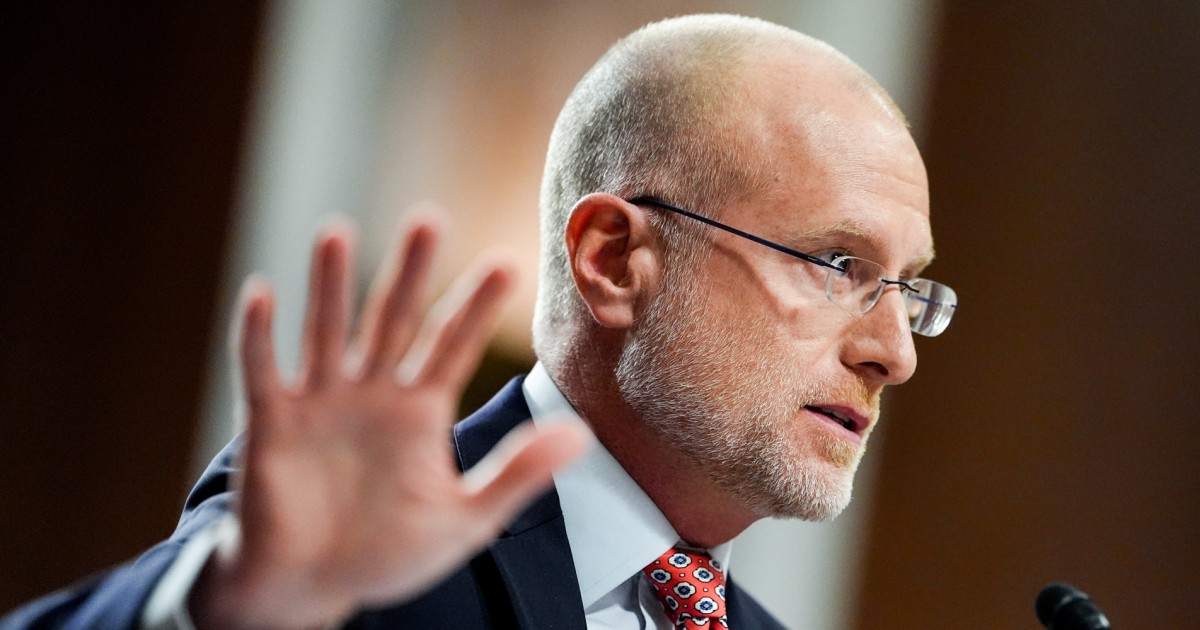
Federal Communications Commission Chair Brendan Carr, testifying Wednesday before a Senate committee, said the regulatory body is not an independent government agency — a position that counters his previous public statements and the office’s own website.
In an exchange with Sen. Ben Ray Luján, D-N.M., Carr said the FCC is “not formally an independent agency” because, he said, commissioners can be removed by the president.
Luján asked whether an FCC online mission statement characterizing the agency as “independent” was “lying.” In response, Carr said, “possibly.”
The word “independent” appeared on the mission statement webpage as recently as October, according to a cached version reviewed by NBC News, but it was no longer there on Wednesday afternoon as Carr testified.
In response to a request for comment on the website change, an FCC spokesperson said: “With the change in Administration earlier this year, the FCC’s website and materials required updating. That work continues to ensure that they reflect the positions of the agency’s new leadership.”
Carr previously described the agency as an independent body. In an April 2021 news release, for example, Carr accused congressional Democrats of transgressing the “FCC’s status as an independent agency.”
Anna M. Gomez, the lone Democratic commissioner on the FCC and an appointee of former President Joe Biden, disagreed with Carr, telling Luján the FCC is an independent agency and “should be.”
Wednesday’s testimony came as the Supreme Court appears poised to grant the president far greater control over traditionally independent government agencies. The case before the court stems from Trump’s firing of Federal Trade Commissioner Rebecca Slaughter.
Traditionally, the independence of federal agencies was seen as a way to insulate their employees from political pressure and allow them to do their work impartially. The FCC was created in 1934 by an act of Congress and given regulatory jurisdiction over radio and telecommunications.
The modern incarnation of the FCC does not regulate streaming platforms like Netflix and YouTube, limiting the sitting chairman’s influence over what Americans see on their screens.
The question of the FCC’s independence from the White House has loomed over Carr, who was appointed to head the agency at the start of the president’s second term after previously serving as one of its commissioners.
Carr, whose office regulates the broadcast television industry, faced bipartisan criticism after he denounced ABC late-night host Jimmy Kimmel’s comments about the political motivations of the man who assassinated conservative activist Charlie Kirk.
In a podcast interview, Carr seemed to threaten ABC’s broadcast license, saying in part: “We can do this the easy way or the hard way.”
In the wake of Carr’s comments, Nexstar and Sinclair — two major owners of ABC affiliate stations — pulled Kimmel’s show, and ABC briefly suspended him. “Jimmy Kimmel Live!” has since returned to the airwaves, and the comedian has signed a one-year extension with ABC.
Carr faced several questions about the Kimmel controversy during his testimony Wednesday. He said he believes political satire should be considered protected speech, but that broadcasters licensed by the government must comply with a “public interest standard” mandated by Congress.
Sen. Andy Kim, D-N.J., asked Carr whether he believes Trump is his “boss.” Carr did not directly respond to that line of questioning, but he told Kim that Trump has the power to fire him and the FCC’s two other sitting commissioners.
Kim asked: “Would it be appropriate for the president or senior administration officials to give you direction to pressure media companies?”
Carr replied: “Sorry, I’m not going to get into hypotheticals.”
Carr, 46, known for wearing a gold-colored pin modeled on Trump’s profile, practiced law before he joined the FCC in 2012 as a staff attorney. He later was an adviser to former FCC Chairman Ajit Pai.
Trump appointed Carr to a Republican seat on the commission in 2017, during his first term, before elevating him to the top job.
In the intervening years, Carr had raised his profile inside the Republican Party and the wider conservative ecosystem. He wrote a chapter about the FCC for the Heritage Foundation’s “Mandate for Leadership” policy document — better known as Project 2025.
“The FCC should promote freedom of speech,” Carr wrote in the opening to his chapter.



