

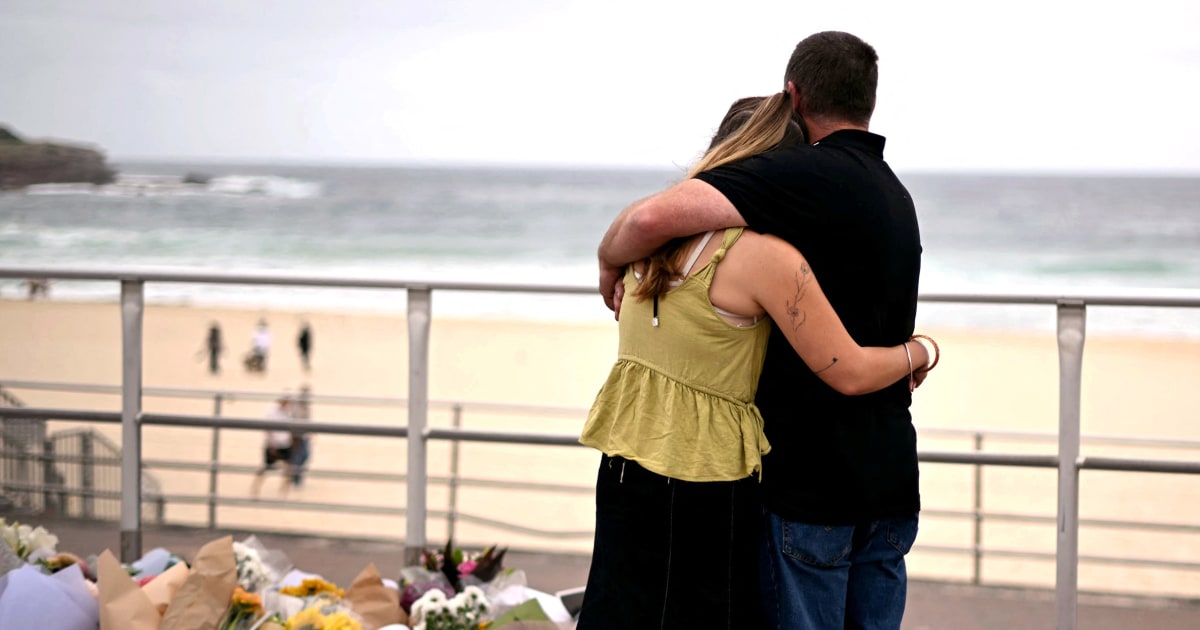
SYDNEY — Hundreds remained on Bondi Beach long after after the sun had set Tuesday.
Many stood silently beneath the waning moon, police helicopters whirring overhead. Some laid bouquets of flowers, which local stores are giving out for free. All were there to pay tribute to the 15 people killed at Sunday’s Hanukkah celebration.
The beach, a worldwide symbol of a free-wheeling iconically Australian way of life, serves as the nation’s spiritual backyard, and the massacre has sent ripples of shock and grief not only through Sydney but the nation.
The attack, which authorities say is an act of terrorism inspired by Islamic State ideology, “was targeted at the Jewish community, but Bondi Beach is open and a place for everyone,” Rabbi Alon Meltzer told NBC News Tuesday as he headed to the coroner’s office to sit with the bodies of those slain.
“So many people will be living in trauma,” he said.

Kyle Korus, 15, said was with a group of friends at the celebration when the shooters opened fire and they took cover behind a piece of concrete.
“I look to my left, there is this guy on the floor, his head split open, his brain on the floor, there’s blood everywhere,” he said, adding that when they saw the police had the situation under control, they ran back to help.
The fear was palpable for Bianca Hirschowitz whose 15-year-old son Noah had gone to the beach with Kyle, something she said they did on an almost daily basis, whether it be to meet friends, go swimming or grab an ice cream.
Alerted to the attack by her sister, she said she raced down to the beach after a tracking app showed that Noah was at a pavilion on the beach.
While she said she spotted one of the gunmen on a bridge near the beach but did not fully clock in the danger she was in until she saw two dead bodies covered in white sheets, and another man lying face down.
“There were grown men screaming, children crying,” she said.

But while she “just wanted to get to my son,” Hirschowitz said she couldn’t find Noah for around an hour and he was not answering his phone.
“I was screaming for him, hoping that he would answer,” she said. The more he didn’t answer, the more she feared he had been killed.
Eventually Hirschowitz managed to get through to Noah on the phone, only to find he had returned home.
“I hugged him and I held him very very tight, and I just said we thought you had died,” she said of their reunion.
The attack has set off renewed scrutiny of not only Australian gun laws and efforts to combat antisemitism, but also what authorities knew about the pair who are alleged to have carried out the attack.
Three senior law enforcement officials in the U.S. and Australia told NBC News that investigators had tentatively identified one of the suspects as Naveed Akram. Lanyon identified the older suspect, the father, as Sajid Akram.

Police have said officers fatally shot the 50-year-old father at the scene, while the 24-year-old son “suffered critical injuries” and was hospitalized.
“Early indications point to a terrorism attack inspired by the Islamic State,” Australian Federal Police Commissioner Krissy Barrett told reporters Tuesday, while New South Wales Police Commissioner Mal Lanyon said Two homemade ISIS flags were found in cars belonging to the younger, 24-year-old suspect.
While antisemitic incidents had been on the rise in Australia, survivors say that an attack of this scale was unfathomable, given the stringent gun control laws in Australia.
Hirschowitz said she had moved to the country from South Africa, seeking a life of “stability and security” and that was the case for many years, until Sunday.
“If Australia is for everybody, we should be able to celebrate our own celebrations in peace,” she said. “People are afraid to go to their house of worship,” she added.
Meltzer, the rabbi, echoed her comments and said some of his colleagues and friends were among those killed.
“We need more than just sympathy and empathy,” he said. “We need real action.”



