

For the past couple of years, leaders in Australia’s Jewish community have been seeing a rise in antisemitism and urging the country’s leaders to act.
But Australia, like other countries grappling with a resurgence of what’s been called the “oldest hatred” since the Israel-Hamas war erupted on Oct. 7, 2023, has been slow to react to the threat, Jewish leaders said Monday.
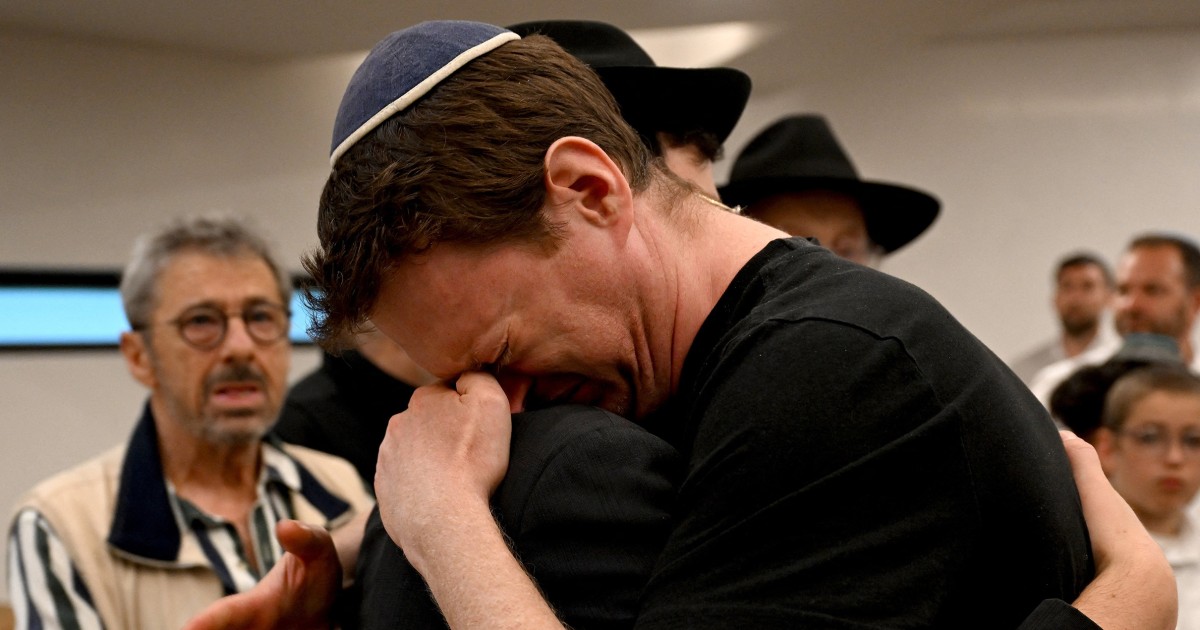
The country saw its deadliest mass killing in nearly 30 years, with the massacre of 15 people this past weekend during a Hanukkah celebration on Bondi Beach.
“We’ve seen every manner of exclusion, abuse, attack, harassment, threats, fire bombings, burning of synagogues,” said Alex Ryvchin, co-chief executive of the Executive Council of Australian Jewry. “This country has changed fundamentally in two years, and it’s culminated now on the beach.”
In the aftermath of the shooting, Prime Minister Anthony Albanese and his National Cabinet vowed Monday to eradicate the “evil scourge” of antisemitism and take other steps like further tightening the country’s already stringent gun control measures and establishing a centralized National Hate Crimes and Incidents Database.

Rabbi Abraham Cooper of the Simon Wiesenthal Center in Los Angeles said Albanese and the Australian government have, thus far, been “all talk and no action.”
“This is not the first incident of this kind in Australia, just the worst,” he said. “Warm words of embrace are just not going to cut it. We’re looking for action, changes of policies.”
Rabbi Menachem Gluckowsky, the deputy chief justice of the Chabad Rabbinical Court in Israel, echoed Cooper.
“I think it’s a wake-up call for Australia for sure,” Gluckowsky said. “I think it’s a wake-up call for all countries. This is not just our battle. It’s not just a battle for the Jewish people. This is a battle on evil. Just because you feel you’re right, you can’t gun down people cold bloodedly.”
Gluckowsky likened the Bondi Beach attack to the pogroms that European Jews endured for centuries. He said governments worldwide, and especially in the West, have been slow to respond to rising anti-Jewish hatred.

Both Gluckowsky and Cooper contend that pro-Palestinian demonstrations have fanned the flames of antisemitism. And Australia’s decision in September to formally recognize a Palestinian state was a “signal” to terrorists determined to attack Jews, Cooper said.
“They have allowed Jews to twist in the wind,” Cooper said.
In an interview with the Australian Broadcasting Corporation on Monday, Albanese was asked whether he saw any link between the recognition of a Palestinian state and the Bondi shooting.
“No, I don’t. And overwhelmingly, most of the world recognizes a two-state solution as being the way forward in the Middle East,” the prime minister said.
“My job is to provide support for the Jewish community, is to make it clear that Australians overwhelmingly stand with the Jewish community at this difficult time,” he added in response to a follow-up question.
Cooper’s denunciation came a day after a father-son terror team opened fire on a Hanukkah celebration taking place on the iconic beach. The 50-year-old father died at the scene. His 24-year-old son remained in a coma in a hospital on Monday, officials said.
So far, Australian officials have not released their names or divulged a motive. But since the Israeli-Hamas war erupted two years ago, Australian lawmakers and experts have reported a surge in antisemitic incidents.
The Hamas-led attack on Oct. 7, 2023 killed 1,200 people in Israel, and the Israeli military response led to the death of over 70,000 in the Gaza Strip, according to Palestinian health officials.
Jewish Australians have faced “an unprecedented rise in antisemitism across the country,” an Australian parliamentary inquiry into antisemitism concluded in October 2024.
Earlier this month, the Executive Council of Australian Jewry reported 1,654 anti-Jewish incidents across the country between Oct. 1, 2024, and Sept. 30, 2025.
There were 2,062 such incidents the year before, an all-time high for Australia, the organization reported.
Homes, cars and schools were vandalized with anti-Israel messages. A synagogue and childcare center were targeted by arsonists. Two nurses were suspended for posting online that they would kill or not treat Jewish patients.
And police in January foiled what they said was an antisemitic plot when officers seized a travel trailer packed with explosives.
Most of the threats were reported in Sydney and Melbourne, which are Australia’s biggest cities and home to 85% of the country’s Jewish population of around 117,000.
Previously, Australian lawmakers responded to the threats by passing tough hate crime laws that include mandatory jail time for giving a Nazi salute in public.
Now they’re looking into tightening Australia’s gun laws to make it harder for residents to get their hands on the kind of high-powered rifles and shotguns that were reportedly used Sunday to stain the sands of Bondi Beach with blood.
Antisemitism online has also spiked in recent years, fueled by anger around the conflict between Israel and Hamas and enabled by a new freewheeling social media landscape where content moderation on sites like X and others has been loosened.
The Institute for Strategic Dialogue, a think tank that researches misinformation and extremism, found a 4,963% increase in the number of antisemitic YouTube comments on conflict-related videos, compared to the days before the Oct. 7 attack.
For months after the incident, the institute found that fringe platforms like 4chan, Bitchute, Gab and Telegram saw a 50% increase in daily antisemitic comments made.
Sunday’s shooting was the deadliest mass shooting in Australia since April 1996, when a gunman armed with two semi-automatic weapons went on a rampage in the tourist town of Port Arthur, on the island of Tasmania, that left 35 dead and 23 wounded.
That bloodletting resulted in legislation that banned ownership of most automatic and semiautomatic rifles and drastically reduced the number of mass killings in Australia.
Growing emotional, Gluckowsky said they are “going to stand strong and carry on” despite what happened on Bondi Beach.
“We won’t be intimidated or inhibited of who we are as Jews,” he said.
Matt Bradley reported from Israel, Ben Goggin and Corky Siemaszko reported from New York City.



