

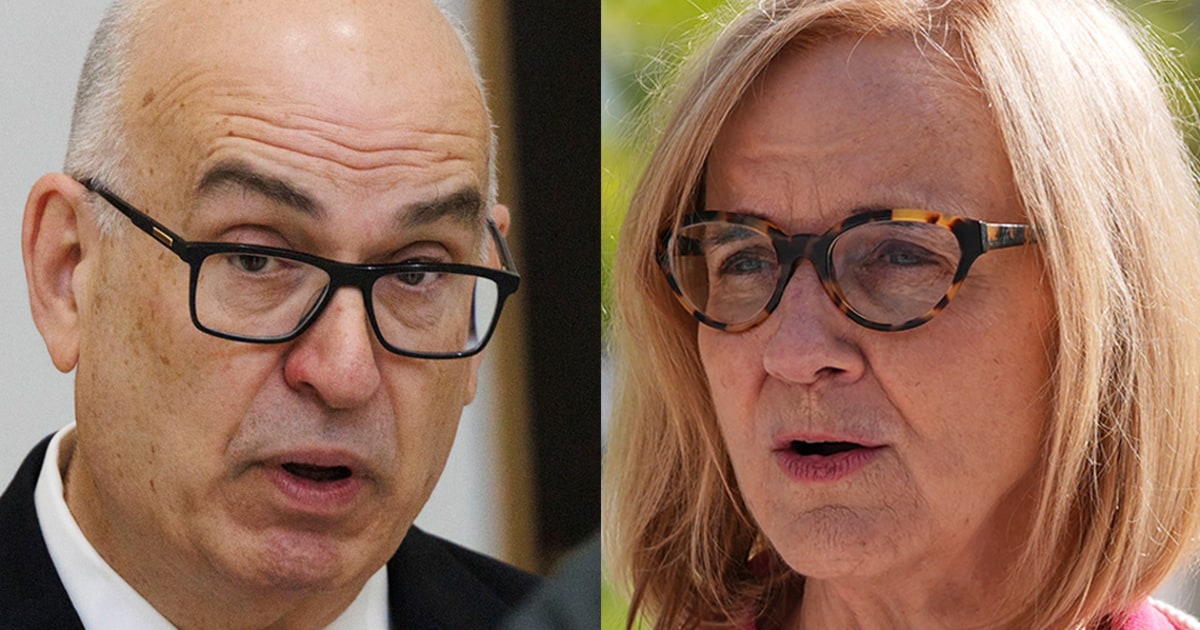
Welcome to Miami, where the two major parties are watching the latest Republican-held office that Democrats are making a last-minute push to flip this year — the city’s mayoralty.
The city hasn’t had a Democratic mayor since the late 1990s, and dramatic shifts among Hispanic voters, particularly in South Florida, have melted away Democrats’ edge in recent elections.
But unlike in other recent special elections for Republican-controlled seats, Vice President Kamala Harris narrowly carried the city of Miami last year while losing Miami-Dade County. That means a Democratic flip is well within reach for former County Commissioner Eileen Higgins, who is running against Republican Emilio T. González, a businessman and former city manager endorsed by President Donald Trump.
Both have pitched themselves as clean breaks from past city politics and promise to address affordability issues, which looms especially large in South Florida, as it has done across the country.
While the candidates’ solutions to those problems may be local, the race has been swept up into a national fight, as both parties jockey for political momentum ahead of next year’s midterm elections. In Miami, that means a technically nonpartisan election with clear partisan trappings.
Higgins and González advanced to Tuesday’s runoff after a blanket primary on Election Day last month. Since no candidate won the majority of the vote, the two candidates with the most votes moved on to the December runoff. Higgins finished atop the 13-candidate field with 36% of the vote to González’s 19%, and the top two Democratic-affiliated candidates in the nonpartisan race combined for a majority of the vote.
Democrats come into Tuesday’s election energized by their relative overperformance in high-profile special elections this year and believe a victory could add to the political winds blowing their way ahead of next year’s midterm elections.
That’s why the national party is jumping in to lend a hand, alongside a parade of Democratic politicians from across the country, including Sen. Ruben Gallego of Arizona, former Chicago Mayor Rahm Emanuel and former Transportation Secretary Pete Buttigieg.
But Republicans are fighting to keep their grip on the mayorship, which they’ve held since 2009 (an independent was mayor from 2001 to 2009). Trump has weighed in on the race, hoping to rally Republicans to González’s side, and prominent Florida Republicans like Gov. Ron DeSantis, Sen. Rick Scott and Rep. María Elvira Salazar have sought to boost their party’s candidate, too.
In an interview, Higgins pitched herself as tightly focused on quality-of-life issues like building more affordable housing, fixing permitting reform and upgrading city infrastructure, pointing to her tenure on the Miami-Dade County Commission and past work as the Peace Corps director in Belize.
She argued that those kinds of changes are commonsense, achievable solutions that can cut costs for the city and help mitigate issues related to hurricanes and flooding, all directly affecting residents’ bottom lines.
“There are many approaches to affordability that local governments have in their own hands even though we aren’t in control of tariffs — which, by the way, is creating a huge affordability crisis,” she said.
Higgins also contrasted herself with the national GOP, and González, over the issue of immigration and the Trump administration’s widespread deportations. González was the head of U.S. Citizenship and Immigration Services in President George W. Bush’s administration and served on Trump’s homeland security transition team.
“This year in the Hispanic and Haitian communities, I’m hearing something different. They are afraid. It’s the first time in any of my elections people are telling me they’re afraid of their government,” she said, adding that she has met people on the campaign trail who said they knew people who had been sent to the “Alligator Alcatraz” detention center.
The two candidates discussed the issue at a debate CBS Miami hosted in November, when González said that he supports “rounding up people who commit crimes” but that immigration enforcement is “a federal issue.”
González is a known commodity in the city, too. After his stint in the Bush administration, he worked as a businessman, as CEO of Miami International Airport and as Miami’s city manager. González has pitched that on-the-job experience as city manager as one reason he could hit the ground running as mayor, but he has distanced himself from the city’s politicians by highlighting how he fought an effort to delay the election a year.
In media appearances and on the campaign trail, González has talked about fighting overdevelopment and backing DeSantis’ push to end homestead property taxes as a way to address affordability issues.
“We want people to own their homes, to stay in their homes. Right now, our affordability crisis is to the point that people are being property-taxed out of their homes,” he told Fox News over the weekend.
Tuesday’s runoff comes with Democrats still enjoying their gubernatorial victories in New Jersey and Virginia last month, as well as other important election wins in states like Pennsylvania and Georgia. Results in the two governor’s races show the Democratic nominees made especially big gains compared with 2024 in heavily Latino municipalities, raising questions about whether Trump’s success in making inroads with those voters is durable for other Republicans.
Florida Democrats have had little to boast about in recent years, with the longtime swing state turning noncompetitive at the presidential level in 2024, two years after DeSantis won re-election by a historic margin. But Tuesday’s election provides them with the possibility of something to hang their hat on, particularly as DeSantis and other Republicans have raised warnings about whether their party’s base will still turn out without Trump on the ballot.
González argued on Fox News that turning the city over to Democrats for the first time in decades is a bad idea.
“People understand what’s at stake here. This isn’t just some ho-hum municipal election; this is big. [The] Democratic Party, progressives, have tried and succeeded in going after a lot of big cities throughout the United States,” he said. “They can’t win at the national level. They can only win at the state level, in some areas, and now they’re going for cities, and we’re not going to allow that here in Miami.”
Higgins told NBC News she welcomed the nationalization of the race, because it drives attention she hopes will ultimately lead to stronger turnout.
“I’m excited to have the national parties talking about Miami,” she said. “The more the national media and these parties on both sides tell people to vote, the higher voter participation will be. Sure, I hope they vote for me. But nothing makes me happier than high voter turnout.”



