

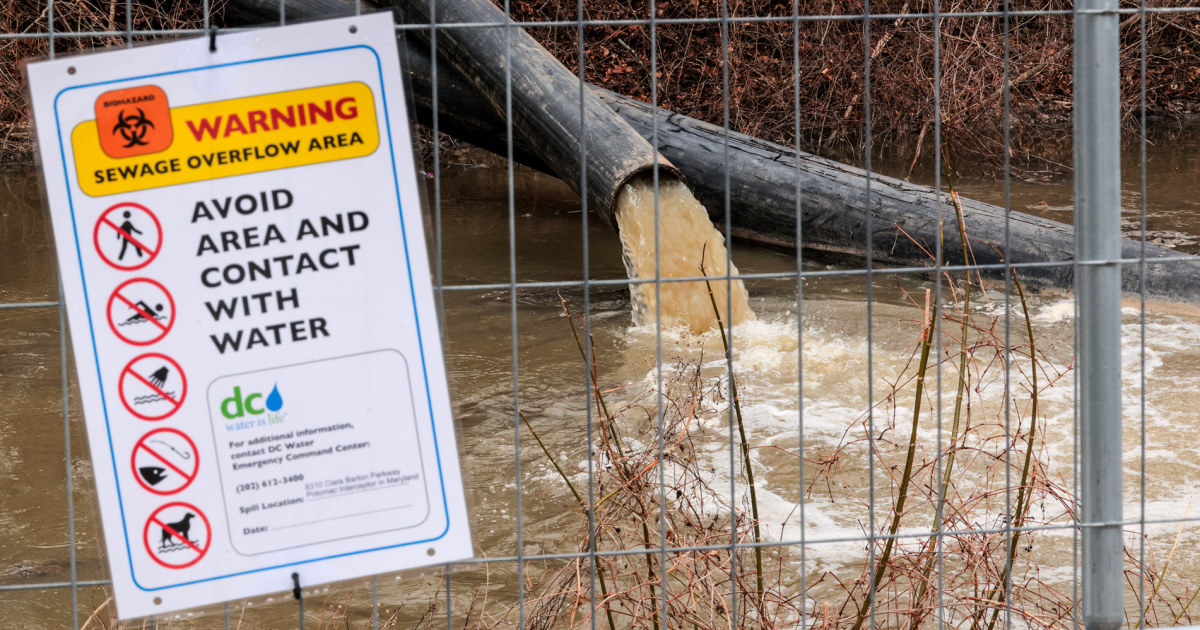
An ecological crisis of “historic proportion” is underway in the Potomac River after a massive sewer pipe collapse north of Washington, D.C., the U.S. Environmental Protection Agency said Tuesday.
The millions of gallons of diseased waste polluting the major waterway that winds through the nation’s capital is one of the largest sewage spills in U.S. history, according to the University of Maryland.
E.coli bacteria levels in the Potomac were hundreds of times higher than the level the EPA considers safe when the water was tested this week at the site of the spill, officials from utility company DC Water said Tuesday.
Some 243.5 million gallons of raw sewage have poured into the Potomac since the Jan. 19 mishap, DC Water said.
But the waters near the capital city’s Georgetown neighborhood fell within the EPA’s safety limits when tested on Monday and weren’t a risk for gastrointestinal illness and skin infections — largely because the river has been frozen over for weeks.
DC Water has told area residents to avoid the untreated sewage. They urge anyone who comes into contact with the wastewater to leave the area immediately, wash exposed skin thoroughly with soap and clean water, and seek medical attention if symptoms occur.
Montgomery County Fire & Rescue Squad in Maryland is warning their first responders to treat any emergency calls in or near the Potomac River spill site as “Hazmat calls,” NBC Washington reports. Responders should wear personal protective equipment during those calls due to the dangerous levels of E. coli and other contaminants in the water.
As for the politics around the water crisis, those continued to be toxic.
“The Potomac Interceptor overflow is a sewage crisis of historic proportion,” the EPA said in their first statement on the disaster. “Never should any American family, community, or waterway ever have to experience this level of extensive environmental damage.”
The EPA, it said, has “the experience and track record to fulfill President Trump’s strong desire to get this mess cleaned up as fast as humanly possible.”
But, the EPA says, neither officials in Maryland, where the sewage pipe burst, nor in Washington, D.C., have sought the EPA’s help.
The EPA’s claim came on the same day that Trump posted on Truth Social that the spill is “not at all” handled by the federal government and that if the governors of Maryland and Virginia, and the D.C. mayor — all three of whom are Democrats — want federal assistance, they will have to ask “politely” for help.
Maryland Gov. Wes Moore rejected the president’s claims and said it was indeed the federal government’s responsibility.
“I know this is breaking news to everyone, but the President is not telling the truth,” Moore said.
Moore said it’s been the job of the federal government to maintain that pipe “for the past century” and that thus far, Maryland’s Department of the Environment has been fixing the pipe and cleaning-up the mess while the EPA has done nothing.
“Now that it is essentially 99% contained,” Moore said, “the President of the United States is finally realizing that this was his job, and he hasn’t been doing it for the past month.”
The 54-mile Potomac Interceptor carries about 60 million gallons of wastewater every day from as far away as Dulles Airport in Sterling, Virginia, to the Blue Plains Advanced Wastewater Treatment Plant in Southwest D.C. for treatment.
By Jan. 24, crews from DC Water were able to complete a bypass to reroute wastewater around the collapsed section of pipe and back into the sewer system.
The remaining emergency repairs to the pipe will be complete by mid-March, according to DC Water.
The long-term fixes to ensure that this pipe remains functional in the years to come will take 9 to 10 months, they said.
“The next critical step is to install a steel bulkhead gate later this week to isolate the damaged pipe section,” DC Water said in a statement. “Once the gate is in place, crews will work to pump out any remaining wastewater at the collapse site and start excavation to remove the rock dam that has been blocking inspection and repair.”
It’s also safe to drink the water in the nation’s capital.
“There is no impact to the drinking water supply,” DC Water Spokesperson Sherri Lewis told NBC Washington. “The sewer system, the water system are completely separate.”



