

This is the online version of From the Politics Desk, a daily newsletter that brings you the NBC News Politics team’s latest reporting and analysis from the White House, Capitol Hill and the campaign trail.
In today’s edition, Steve Kornacki takes stock of the Texas GOP Senate primary as early voting gets underway. Plus, Sahil Kapur reports on the growing support for an elections bill backed by President Donald Trump in the Senate.
Sign up to receive this newsletter in your inbox every weekday here.
— Adam Wollner
John Cornyn fights for political survival as early voting kicks off in Texas
Analysis by Steve Kornacki
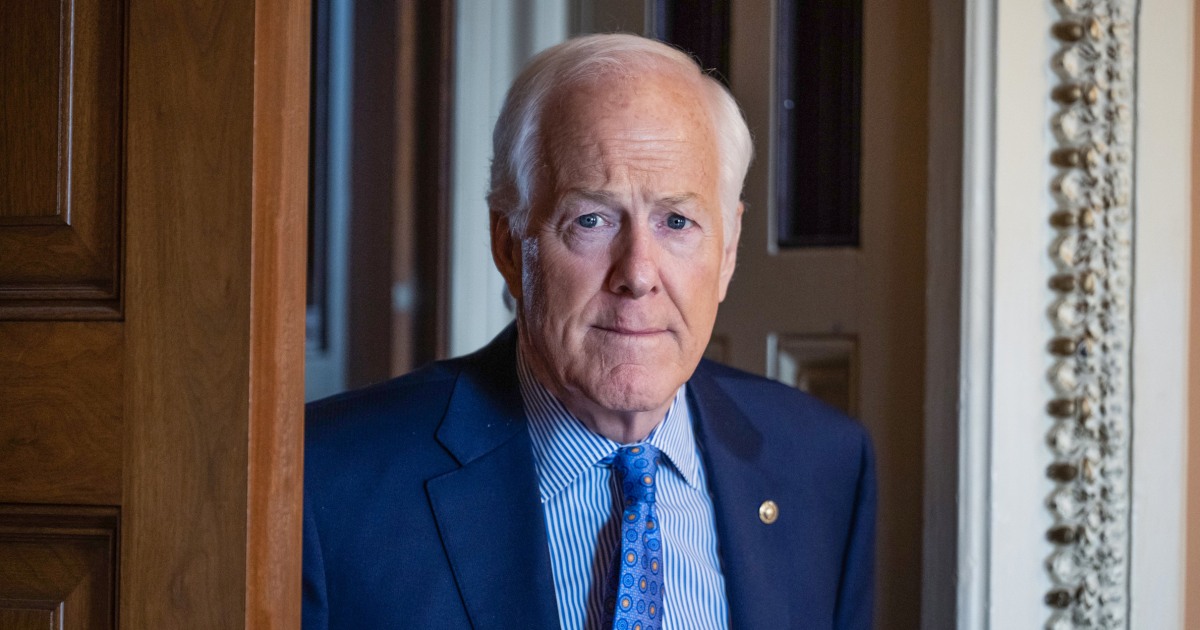
Early voting began today in Texas, where the primary on March 3 will serve as the de facto midterm kickoff. The biggest question: Can GOP Sen. John Cornyn avoid becoming the first incumbent senator since 2012 to be denied renomination?
Most likely, the Republican race will not be formally decided on primary night, with a runoff looming if no candidate breaks 50% of the vote. But the signs are ominous for Cornyn, and an underwhelming showing in the initial round of voting could all but seal his fate.
A poll of likely primary voters from the University of Houston released last week showed Cornyn lagging behind Texas Attorney General Ken Paxton, 38% to 31%, with Rep. Wesley Hunt running in third with 17%. More troubling for Cornyn, the poll showed him losing by 11 points to Paxton in a one-on-one runoff. And it found that Paxton was far more popular with GOP voters: He had a 50-point net favorable rating compared with 31 for Cornyn.
Cornyn and his allies are flooding the airwaves with attacks on Paxton, who was impeached by the GOP-controlled Texas House in 2023 and then acquitted in the state Senate. He also agreed in 2024 to pay about $300,000 as part of a deal to end a nearly decade-long securities fraud case. Cornyn’s hope is that Republican voters can be turned away from Paxton by fear that he would make a ripe target for Democrats and put the seat at risk in November.
But the University of Houston poll found both Cornyn and Paxton running almost identically against either potential Democratic nominee, Rep. Jasmine Crockett or state Rep. James Talarico. Paxton can also seek to reassure GOP voters by pointing to his own ability to win re-election as attorney general in 2022, even with his legal woes on full display. Paxton won that election by 9.8 points, not far off Republican Gov. Greg Abbott’s 10.9-point margin in his own re-election race.
If they are already inclined to take a chance on him, Texas Republicans may also be willing to extend Paxton the benefit of the doubt based on President Donald Trump’s unexpectedly dominant victory in the state in 2024 (nearly 14 points) and the fact that no Democrat has won a statewide contest in 32 years. Republicans are also confident that both Crockett and Talarico have taken positions that will make them unelectable in the fall.
Ultimately, Cornyn’s best — and perhaps only — chance at survival may hinge on convincing Trump to endorse him. The president, who maintained his neutral posture in comments to reporters last night, does not like to attach his name to candidates who don’t have a clear path to victory. Obviously, the further Cornyn finishes behind Paxton on March 3, the weaker he would be heading into the runoff — and the tougher his sell to Trump would become.
Polling in the Democratic primary has been tougher to gauge. The University of Houston survey put Crockett ahead by 7 points, 46% to 39%, but a January Emerson College poll gave Talarico the lead and another survey from Texas Public Opinion Research showed a dead heat.
➡️ Related: “Late Show” host Stephen Colbert said CBS did not air his interview yesterday with Talarico out of fear of the Federal Communications Commission. Read more →
Support for Trump’s election bill is growing in the Senate, but Democrats could still block it
By Sahil Kapur
The SAVE America Act to require proof of citizenship nationwide to vote now has support from 50 Republican senators.
The bill is supported by President Donald Trump and passed the House last week, meaning the Senate’s 60-vote filibuster rule is the only thing standing in the way of it becoming law.
The tally guarantees a battle over the bill on the Senate floor as Majority Leader John Thune, R-S.D., has promised a vote. But he warned last week that there are “not even close” to enough votes for getting rid of the filibuster, despite Trump’s calls to do so. If the filibuster remains intact, the legislation will still fail as Democrats are certain to use every tool to block it.
Sen. Mike Lee, R-Utah, the chief sponsor of the bill, is pushing Republicans to use existing rules to force Democrats to engage in a “talking filibuster” on the Senate floor. The idea is to tire out opposing Democrats and pass it. But the tactic is a long shot, viewed by previous Senate majorities as doomed to fail if attempted. The rules make it considerably easier for a filibustering minority to sustain the 60-vote threshold than for a majority to break their will and advance a bill with 51 votes.
Sen. Susan Collins, R-Maine, who faces a competitive re-election bid this fall, became the 50th Republican supporter of the legislation. She said the revisions to the bill resolve her earlier concerns by easing the proof-of-citizenship rule for casting a ballot, instead requiring states to see it only when registering a person to vote.
But Collins made clear she does not support gutting the filibuster to pass it.
“I oppose eliminating the legislative filibuster,” Collins said. “The filibuster is an important protection for the rights of the minority party that requires senators to work together in the best interest of the country.”
Some in the party have not signed on to the measure, including Sens. Lisa Murkowski, R-Alaska, and Mitch McConnell, R-Ky.
🗞️ Today’s other top stories
- ⚫ RIP: Jesse Jackson, the Baptist minister and two-time presidential candidate whose booming oratory and populist message propelled the Civil Rights Movement in the decades after the assassination of Martin Luther King Jr., died at the age of 84. Read more →
- 👀 Exclusive: Homeland Security Secretary Kristi Noem’s relationship with U.S. Coast Guard officials has become strained throughout her first year leading the department. Read more →
- 🇮🇷 Latest from Iran: The U.S. and Iran have reached an understanding on the “guiding principles” in nuclear talks, Tehran’s foreign minister said, though he cautioned that work still needs to be done to reach an agreement and head off the threat of an American military attack. Read more →
- 🚣 Sewer politics: Trump said the federal government would step in to “protect” the Potomac River after a major sewage spill, accusing local officials of mismanagement. Read more →
- ➡️ On the Hill: Rep. Randy Fine, R-Fla., prompted calls for his resignation from Democrats and a major Islamic civil rights group after an anti-Muslim social media post. Read more →
- 👽 In a galaxy far, far away: Former President Barack Obama clarified that he saw “no evidence” that aliens are real when he was in office, after declaring the existence of extraterrestrials during a podcast appearance. Read more →
That’s all From the Politics Desk for now. Today’s newsletter was compiled by Adam Wollner.
If you have feedback — likes or dislikes — email us at politicsnewsletter@nbcuni.com
And if you’re a fan, please share with everyone and anyone. They can sign up here.



