

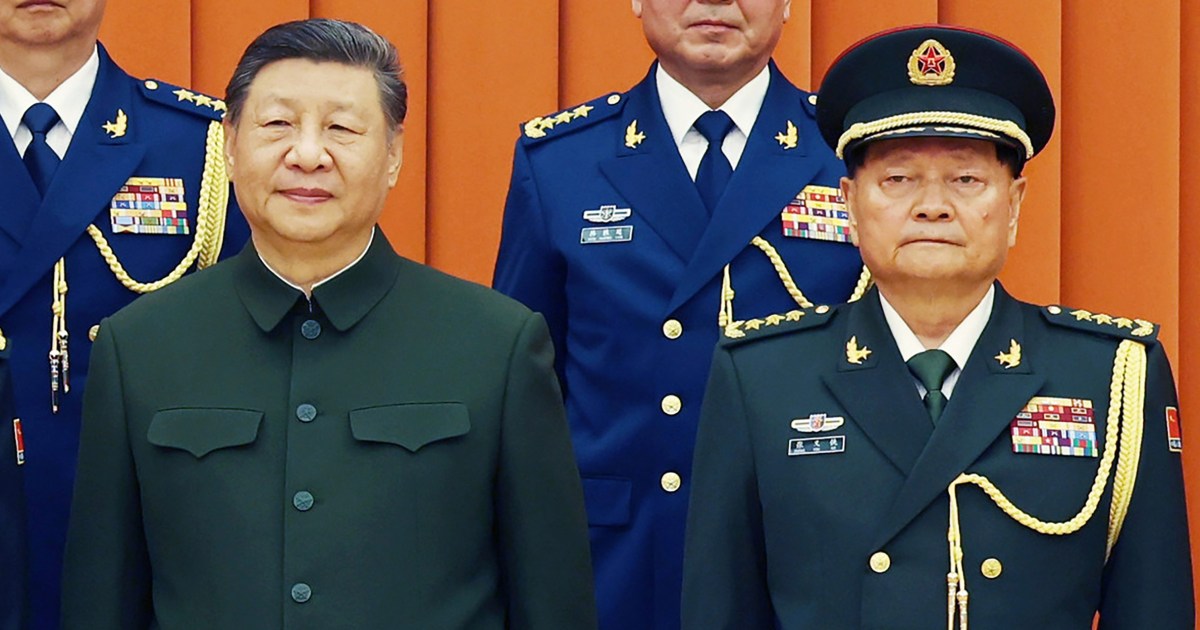
The downfall of China’s top general, second in command and once a close ally of President Xi Jinping, has thrown the leadership of the country’s military into turmoil and raised questions about Taiwan’s future.
The Chinese Defense Ministry said in a statement Saturday that Gen. Zhang Youxia, vice chairman of the Central Military Commission which controls the armed forces, was under investigation and accused of serious “violations of discipline and law.”
Liu Zhenli, another People’s Liberation Army general and a lower member of the commission who was in charge of the Joint Staff Department, was also put under investigation, the ministry said.
The statement gave no details about the allegations against them or the charges they were facing. But an editorial Sunday in the Liberation Army Daily newspaper, the mouthpiece of the country’s armed forces, suggested that Zhang, 75, was accused of corruption and possibly disloyalty to Xi.
Zhang and Liu, it said, “seriously trampled on and undermined” the system of responsibility under the military commission’s chairman — Xi himself. The pair had also “gravely fostered political and corruption problems that weakened the Party’s absolute leadership over the military,” it said, adding that this had “caused immense harm” to China’s combat readiness.
Asked about Zhang at a regular briefing of reporters in Beijing, a Chinese Foreign Ministry spokesperson cited unfamiliarity with the matter. But the page with Zhang’s biography on the PLA’s official website has been pulled down, suggesting he may have fallen out of favor.
Zhang was previously considered “untouchable,” according to Alessandro Arduino, an expert in Chinese security at the Royal United Services Institute, a London-based think tank.
“This is a reminder coming directly from President Xi Jinping, that political loyalty stands well before combat readiness,” he told NBC News in a telephone interview Monday. “Political disloyalty is a cardinal sin inside the party. And the message is clear: it’s a political accusation,” he said. “I think the message is extremely clear, no one is safe.”
Xi could have let Zhang, 75, retire to save face, he said, adding that this was “very important in China.” Instead, Xi had allowed “a huge political accusation” to be leveled against his longtime ally, Arduino said.
China’s military has undergone a sweeping anti-corruption purge in recent years, which has seen People’s Liberation Army generals, admirals, government ministers and other officials removed from their posts.
Since coming to power in 2012, Xi has launched a range of anti-corruption drives through various government departments.
More recently the focus has been on the armed forces. In October, the ruling Communist Party expelled He Weidong, the other vice chair of the military commission, and replaced him with commission member Zhang Shengmin. And in 2024, the party expelled two former defense ministers over corruption charges.
But the removal of Zhang, a longtime confidant of Xi and a combat veteran from China’s 1979 conflict with Vietnam, is being seen by some analysts as the most significant ouster yet, and one that will create a major upheaval at the top of China’s military power structure.
Of the six generals Xi appointed to the commission in 2022, only one is left, allowing the president to consolidate power, but also heightening the risk of a military miscalculation when it comes to Taiwan, according Steve Tsang, the director of the China Institute at SOAS University of London.
“Removing generals like Zhang means that there will not be any general who would dare to advise Xi against a military adventure when the time comes, and this increases the risk of a miscalculation,” he said in an email Monday.
Xi has long harbored ambitions of reuniting the self-ruled territory of 23 million people with China and his military regularly launches live-fire drills around the island, featuring aircraft and warships.

Officials in Taipei are closely watching what they have called “abnormal” changes to China’s military leadership and will use a range of methods to decipher Beijing’s intentions, Taiwanese Defense Minister Wellington Koo said Monday.
“Xi will not order an invasion unless he is certain of victory, but no general will now dare to advise caution if Xi asks: ‘Is the PLA now ready to liberate Taiwan for the greater glory of China?’” Tsang said, adding that the world was “less safe” after Zhang’s removal.
That view was echoed by Arduino at RUSI, who said Zhang was one of the oldest high-ranking commanders who fought in the war against Vietnam, “so he knows very well what it means to wage a war, compared to the majority of the PLA that are just training to be combat ready.”
His successor “will show what is going to look like a PLA that is first and foremost politically aligned with the party, and by definition, with President Xi himself,” he added.



