

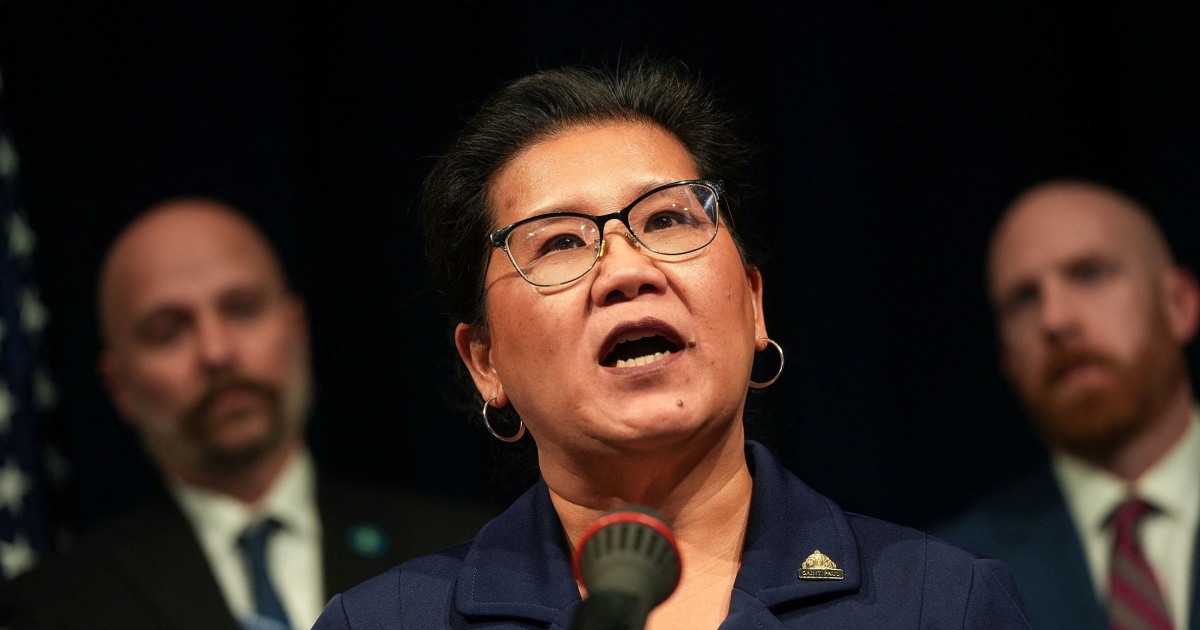
MINNEAPOLIS — Kaohly Her took office as the first woman and the first Asian American mayor of St. Paul, Minnesota, the week an immigration officer fatally shot Renee Nicole Good, a U.S. citizen who lived nearly 15 miles west of her city.
“Nobody ever comes into an office and within the third day of being in office there’s an ICE shooting,” Her told NBC affiliate KARE of Minneapolis in an interview Tuesday. “But I also understand that this is the moment in which you are asked to lead, and so you step up and you lead. … I hope I’m rising to the moment.”
Born in Laos, Her is the first person of Hmong ancestry to become the mayor of St. Paul, which is home to the country’s largest urban Hmong population, according to Pew Research. Neighbors in that community raised concerns this week over a rise in immigration raids targeting people of Hmong descent, with outrage growing after the arrest of ChongLy Scott Thao, a naturalized U.S. citizen who is also a Hmong immigrant.
Videos of the incident Sunday show immigration officers breaking down the door to Thao’s home, arresting him and escorting him out in freezing conditions wearing only shorts, a blanket and sandals. Thao, 57, was returned to his home later in the day.
Her recognized Thao when she saw the images. He is her friend Louansee Moua’s brother-in-law. Moua had written a Facebook post decrying what happened to Thao.
“When I saw what she had posted, I called her immediately, and the next morning she and I touched base and talked about what had happened,” Her said. “It was heartbreaking to watch somebody get dragged out of their home.”
“I don’t know how anybody looking at that could ever justify the treatment of another human being that way,” she added.
Department of Homeland Security spokesperson Tricia McLaughlin said Monday that Thao’s arrest was part of a targeted operation seeking two sex offenders who lived at his address. On Tuesday, the agency identified two men from Laos and said both are wanted on suspicion of sexual assault. It was unclear Tuesday whether the two men were the targets when officers entered Thao’s home Sunday.
Thao’s family said in a statement Monday that the agency’s account did not reflect their firsthand knowledge of the events or the living situation at the residence.
“The only individuals residing at the home are Mr. Thao, his adult son, his daughter-in-law, and his young grandson. The family does not know the individuals referenced in DHS’s statement,” the family said.
They also said officials did not present a warrant or request ID before he was detained.
‘Going door-to-door’
Her, a Democrat, defeated Republican incumbent Melvin Carter in November’s election, a month before Minnesota became the site of the largest DHS operation cracking down on immigration, resulting in thousands of arrests and anti-ICE demonstrations.
After 3,000 immigration officers and agents were deployed across the Twin Cities area, Her has heard “firsthand, personal accounts” from her constituents about their encounters with them, she said.

“They are going door to door,” Her said in the interview with KARE. “They’re targeting you by the way that you look and the way that you sound. It’s unbelievable to me that that’s how we are looking at executing our operations at the highest level of this country.”
“I think a lot of people want to believe that we are exaggerating what we’re experiencing here, but that’s just not true,” Her added.
McLaughlin of DHS told NBC News in an email Wednesday that “allegations that ICE engages in ‘racial profiling’ are disgusting, reckless and categorically FALSE.” She said DHS has the legal authority to use “‘reasonable suspicion’ to make arrests, as allowed under the Fourth Amendment to the U.S. Constitution. The Supreme Court has already vindicated us on this position.”
“A person’s immigration status makes them a target for enforcement, not their skin color, race or ethnicity,” McLaughlin added.
At a news conference Tuesday, Border Patrol Commander at Large Greg Bovino and Marcos Charles, Immigration and Customs Enforcement’s executive director of enforcement and removal operations, touted the arrests of more than 3,000 people in the Minneapolis region since December, including “some of the most dangerous offenders.”
At another news conference earlier Tuesday, law enforcement leaders across Minnesota’s metro areas decried the tactics immigration officers used to make those arrests, saying they have stopped people — including an off-duty police officer — based on the color of their skin.
Brooklyn Park Police Chief Mark Bruley said immigration officers stopped one of his officers while she was driving. The agents demanded her paperwork even though she is a U.S. citizen.
“When she became concerned about the rhetoric and the way she was being treated, she pulled out her phone in an attempt to record the incident, the phone was knocked out of her hands, preventing her from recording it,” Bruley said. “The [agents] had their guns drawn during the incident, and the officer became so concerned she was forced to identify herself as a Brooklyn Park police officer in hopes of slowing and de-escalating the incident.”
After she told them she was a police officer, the ICE agents left without any further questions or comments, he added.
A DHS spokesperson told NBC News on Wednesday that the agency “is able to find no record of ICE or Border Patrol stopping and questioning a police officer.”
“Without a name, we cannot verify these claims. We will continue to look into these claims,” the spokesperson wrote in an email.
Asked to respond to the concerns Minnesota’s law enforcement leaders expressed Tuesday, Bovino said, “Those tactics are born of necessity.”
“What we do is legal, ethical and moral,” he added.
State and city leaders in Minnesota have been at odds with the federal government over the legality of their immigration operations in the region.
The city of St. Paul, alongside Minneapolis and the state of Minnesota, sued the federal government last week to stop the deployment of thousands of immigration agents. This week, the Justice Department then subpoenaed Minnesota Gov. Tim Walz, Minneapolis Mayor Jacob Frey and Her, among other state leaders, as it investigates whether state officials conspired to impede law enforcement during the Trump administration’s immigration operations.
“When the federal government weaponizes its power to try to intimidate local leaders for doing their jobs, every American should be concerned,” Frey said in a statement Tuesday. “We shouldn’t have to live in a country where people fear that federal law enforcement will be used to play politics or crack down on local voices they disagree with.”
Minnesota Attorney General Keith Ellison said in a statement that he received a subpoena “for records and documents, not for me personally.”
“Everything about this is highly irregular, especially the fact that this comes shortly after my office sued the Trump Administration to challenge their illegal actions within Minnesota,” he said.
Nicole Acevedo reported from New York City and Maggie Vespa from Minneapolis.



