

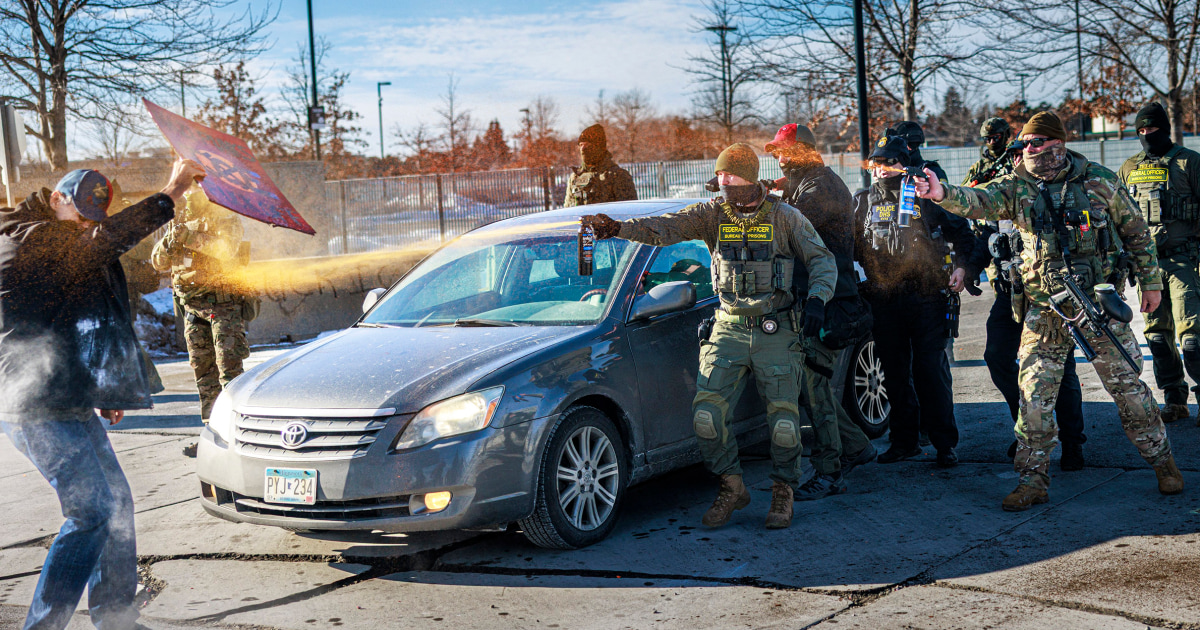
The focus of Operation Metro Surge, as the Trump administration has branded this latest immigration effort, appears to have broadened beyond mass deportations and has included confrontations with anti-ICE protesters. The shooting of Good and the scope of the deployment has heightened the tense mood in a nation already bitterly divided over immigration issues and the Trump administration’s tactics. Interviews with neighbors, community leaders and organized protesters reveal a sense of being under invasion.
On Wednesday night, a man was shot in the leg after DHS said he attacked a federal officer with a snow shovel or broom handle. “Fearing for his life and safety as he was being ambushed by three individuals, the officer fired defensive shots to defend his life,” the department said.
Mayor Jacob Frey said at a news conference after Wednesday’s shooting that the city was being put in an “impossible situation.”


“We are trying to find a way forward to keep people safe, to protect our neighbors, to protect order,” Frey said, while also warning protesters against “taking the bait.” He added that the city has 600 police officers compared to the 3,000 federal immigration officers present. Of that number, more than 2,000 are ICE personnel, hundreds are Border Patrol agents and others are from Justice Department agencies, federal law enforcement officials told NBC News.
A group of area residents visiting Good’s memorial site on Tuesday described masked immigration officers wearing camouflage going door to door, saying they were looking for non-U.S. citizens. They, and others interviewed, described it taking place around Lake Street, Uptown and the Powderhorn neighborhoods.
Those actions reflect what Vice President JD Vance said federal officers would be doing.
“I think we’re going to see those deportation numbers ramp up as we get more and more people online, working for ICE, going door to door and making sure that, if you’re an illegal alien, you’ve got to get out of this country and if you want to come back, apply through the proper channels,” Vance said on Fox News last week. He also suggested earlier that the ICE officer who shot Good would have “absolute immunity.”
Good’s killing has shaken a Midwestern city already carrying deep wounds from the murder of George Floyd by a Minneapolis police officer in 2020. In the days since Good’s fateful encounter with an armed ICE officer, there was no letup by law enforcement. In interviews, neighbors who live near the street where the 37-year-old mother and U.S. citizen was killed say the community has had no time to recover.

One resident who spoke with NBC News described their own arrest hours after Good was killed, providing video evidence of the encounter. They said they were monitoring an immigration operation when officers said their vehicle was in the way. They believed the officers had space to go around their car, which was seen in the video as being positioned horizontally on the street.
The video showed officers breaking the windows of the person’s car, before reaching in to pepper-spray both the passenger and the driver. The person, who asked not to be named for fear of retaliation, said they were punched in the face after pulling down an officer’s mask who was dragging them out of the vehicle.
“I was just so angry. I said: ‘Show yourself, coward!’” they said.
The person said that after being thrown to the ground and arrested, they were taken to an ICE facility at the Whipple Building, which they described as bursting at the seams with more than 20 people crammed into each cell that, in this person’s experience, could reasonably feel too crowded with five people.

The Department of Homeland Security did not respond to a request for comment about their account.
In the days that have followed, intensive arrest operations have continued close to the Good memorial site, with one taking place just a block and a half and another three blocks away. Confrontations between law enforcement and protesters are playing out almost in real time, with both sides revved up.
In one video, an officer reaches out of his passenger’s side window to shoot a stream of red chemicals point-blank into a woman’s face as she stands in front of his car while he tries to drive away.
Where federal officers are present, there are usually also protesters, activists and residents blowing whistles, honking their horns — and invariably filming.
Those videos are then quickly disseminated across the internet, like the one showing officers asking drivers at an electric vehicle station whether they are citizens, and another one in which a screaming woman is dragged out of her car.
As the videos inflame divisions online, the pushback has intensified on the ground.
Drive along a neighborhood street and one can hear the honking break out in traffic, warning that immigration officers are nearby. At busy intersections, like near Karmel Mall, where a diverse mix of residents walk and shop, community members can at times be seen posted up, warning whistles slung around their necks.



