

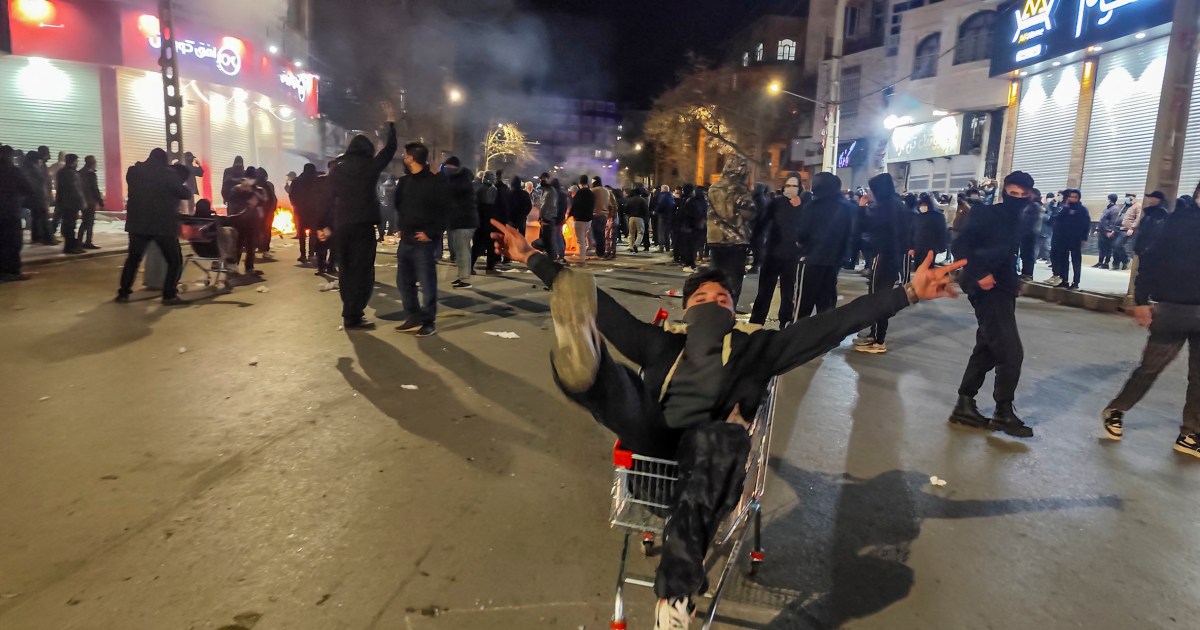
Protests broke out in several cities across Iran on Thursday despite an ongoing violent crackdown by security forces that has left dozens dead and led authorities to shut down the internet nationwide in an attempt to stifle the unrest.
Shops were also shuttered in the main bazaar of Tehran, the capital, and smaller cities Thursday, according to video posted online, as inflation soared and the Iranian currency crashed against the U.S. dollar this week.
The protests, which started for economic reasons, have now taken on a more political tone with demonstrators chanting slogans against Ayatollah Ali Khamenei, the highest authority in the country, in Tehran and other cities.
NetBlocks, an internet monitoring group, said on X that the internet had been completely cut off across the country by early evening Thursday local time, a tactic that officials have used during past protests to prevent unrest from spreading and videos of violence leaking out of the country, analysts say.
Iran “is now in the midst of a nationwide internet blackout,” the group said.

Authorities have struggled to contain the protests after 12 days, and top officials have given conflicting messages about how to deal with the unrest.
President Masoud Pezeshkian has offered conciliatory messages and said protesters’ concerns should be addressed, while hard-liners have issued stern warnings: The head of Iran’s judiciary, Gholamhossein Mohseni Ejei, said Wednesday that there would be “no leniency for those who help the enemy against the Islamic Republic.”
Hadi Ghaemi, executive director of the Center for Human Rights in Iran, a New York-based advocacy group, said in a telephone interview: “We know the president doesn’t really control the situation at times like this.
“The security and intelligence forces are going to do what they always do, and they are starting to do it more systematically,” Ghaemi said. “And Ejei made it very clear yesterday that this is the end, the last call, to wrap it up, and they’re coming for them.”
Security forces have not held back, according to rights groups. Amnesty International said in a news release Thursday that the Islamic Revolutionary Guard Corps and the police “have unlawfully used rifles, shotguns loaded with metal pellets, water cannon, tear gas and beatings to disperse, intimidate and punish largely peaceful protesters.”
Officials have also tried to cover up the killings, Amnesty said, by forcing the families of some victims to give interviews to state media blaming accidents or other protesters. Authorities have threatened secret burials if family members do not comply.
The group added that there have been “mass arbitrary arrests.”
The Hengaw Organization for Human Rights, a Norwegian-registered Kurdish watchdog group that monitors rights violations across Iran, reported Thursday that security forces have killed 42 people during the protests, including six children.
The violent crackdown may come at a price. Last week, President Donald Trump threatened to intervene in Iran, without providing details, if more protesters were killed. He repeated the threat Thursday in an interview on “The Hugh Hewitt Show.”
“I have let them know that if they start killing people, which they tend to do during their riots — they have lots of riots — if they do it, we’re going to hit them very hard,” Trump said.
He also added a message for the protesters. “You should feel strongly about freedom. There’s nothing like freedom. You’re brave people. It’s a shame what’s happened to your country. Your country was a great country,” Trump said.
Trump’s warning presents an additional challenge for Iranian authorities who have not been able to contain the unrest in the streets and were alarmed by the surprise U.S. capture last weekend of Venezuelan leader Nicolás Maduro, a close ally.
“Trump’s threat put the system in a catch-22: If the protests grow, it might resort to increasing levels of violence to subdue them. But if they resort to greater violence, they run the risk of U.S. involvement,” Ali Vaez, Iran project director at the International Crisis Group, said in a text message response to questions.
Videos that circulated online Thursday show large gatherings of protesters in the major cities of Tehran, Mashhad — long considered a conservative bastion of government support — and Isfahan, as well as smaller ones such as Kermanshah in western Iran, where demonstrators chanted “Death to dictator.”
A video verified by NBC News that circulated Thursday shows a white sedan ramming into a group of security forces walking on a street in Mashhad.
A video posted by BBC Persian appears to show security forces firing at protesters in the western Iranian city of Dezful, while another video verified by NBC News shows a large fire at the offices of the state broadcaster, the Islamic Republic of Iran Broadcasting, in Isfahan.
So far, neither side is backing down.
“There are still off-ramps for reconciliation for the system to avert a full-on bloody revolution,” Ellie Geranmayeh, a senior policy fellow at the European Council on Foreign Relations, said in a telephone interview. “And we may start seeing indications and signs of that as the protests go into their third, fourth weeks. But we’re not there yet.”



