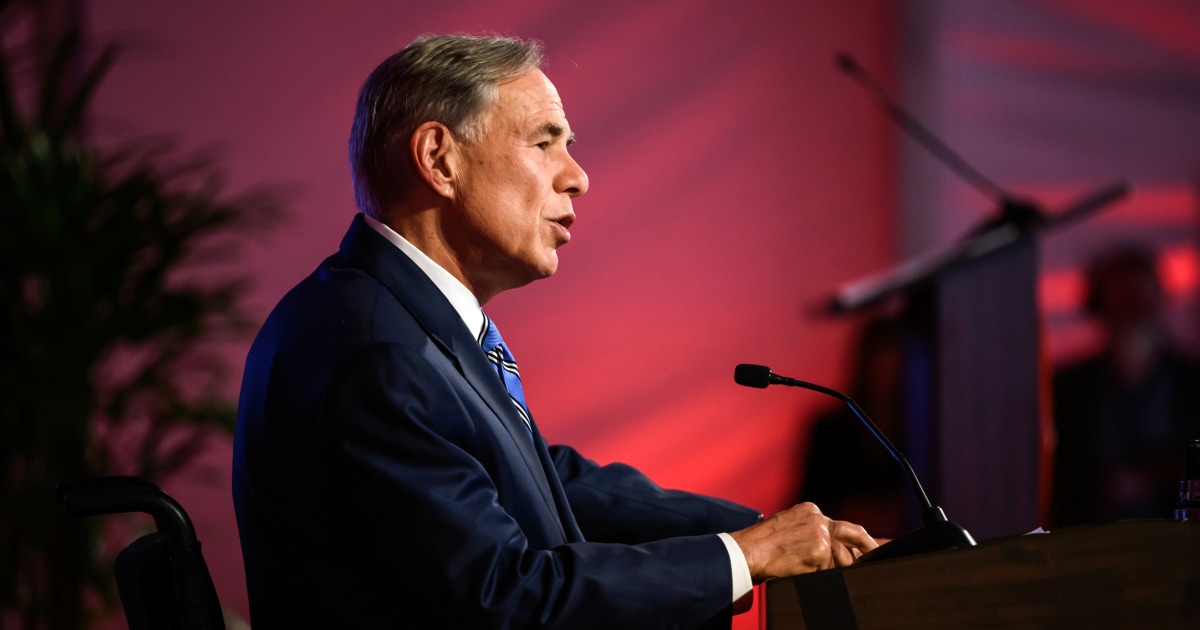
WASHINGTON — The Supreme Court on Thursday allowed Texas to use a new congressional district map in next year’s midterm election that was drawn to maximize Republican political power.
Granting an emergency application filed by Texas Gov. Greg Abbott, the conservative majority paused a lower court ruling that said the map was unlawful because Republican lawmakers, at the direction of the Trump administration, explicitly considered race when drawing new districts.
The unsigned order said that Texas is “likely to succeed on the merits of its claim,” including that the lower court “failed to honor the presumption of legislative good faith” when assessing the state legislature’s motives.
The ruling appeared to be 6-3, with the three liberal justices dissenting.
The map was drawn with the aim of adding up to five additional Republican House seats.
The decision marks a win for President Donald Trump, who filed a brief urging the court to rule in favor of Texas.
The Supreme Court had provisionally put the decision on hold Nov. 21 while the justices weighed what next step to take, in an order signed by Justice Samuel Alito.
Traditionally, states draw new districts once a decade after the census shows how populations have shifted. But this year, Trump, worried about the narrow Republican majority in the House, has repeatedly pushed Republican-led states to draw new maps outside of that normal timeline.
A Trump administration letter earlier this year said the state could be subject to a federal lawsuit if it did not eliminate “coalition districts” in which nonwhite voters of different races constitute the majority.
Thanks to a Supreme Court ruling in 2019, states are free to redistrict in a way intended to maximize the majority party’s political power, but there remain some restrictions under both the Constitution and the Voting Rights Act when race is a factor.
Democrats responded to the Texas plan by launching an effort to draw a new congressional map in California to counteract the potential Republican gains.
In the Texas case, the three-judge lower court invalidated the new map on a 2-1 vote, with the majority opinion authored by Judge Jeffrey Brown, a Trump appointee.
While politics played a role in the maps being redrawn, there was “substantial evidence” that it was a racial gerrymander in violation of the Constitution’s 14th Amendment, he wrote.
In asking the Supreme Court to block the lower court ruling, Texas’ lawyers argued in part that it was too late in the election cycle for federal judges to intervene. The lawyers also said that the new map was clearly designed for partisan gain and denied that there was any racial motive.
“This summer, the Texas legislature did what legislatures do: politics,” they wrote.
The lawsuit was brought by six different groups of plaintiffs, including the League of United Latin American Citizens, or LULAC, the Texas NAACP and two members of Congress, Texas Democratic Reps. Al Green and Jasmine Crockett.
In a court filing, one group of challengers said that “the entire thrust of the governor’s justification for authorizing redistricting” was to remove and replace the coalition districts, meaning that race and not partisan politics was the motive.
This is a developing story. Please check back for updates.