

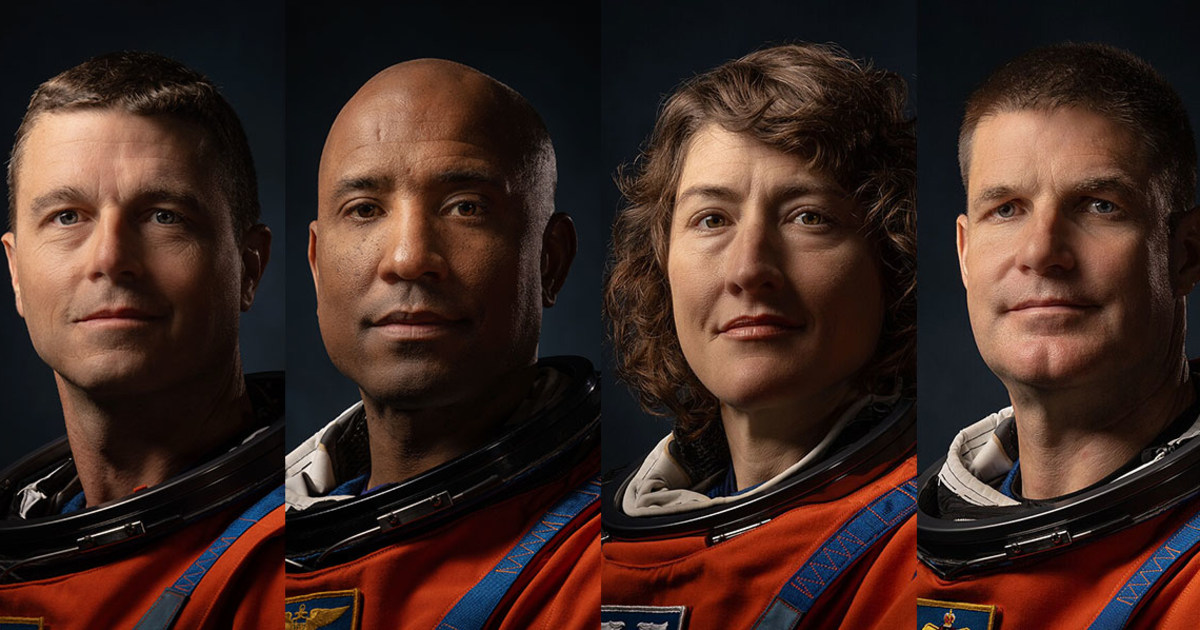
The three NASA astronauts on the mission are spaceflight veterans. Wiseman, who previously served in the Navy and became an astronaut in 2009, spent six months aboard the International Space Station in 2014.

Since losing his wife in 2020, Wiseman has been raising their two children on his own. Being an astronaut, he said, puts a lot of stress and anxiety on family members, and his excitement about the mission is often tempered by feelings of selfishness for the toll it takes on loved ones.
“I’m a single father of two daughters,” he told NBC’s “TODAY” in an interview with his fellow crew members earlier this month. “It’d be a lot easier just to sit on my couch and watch football for the weekend, but at the same time, there’s four humans that were put in a position to be able to go explore and do something that is very unique and rare in this civilization.”

Wiseman added that he hopes the outcome of the mission will justify the sacrifices his loved ones have made.
“We’ve always looked at the moon and said, ‘We’ve been there.’ But for this whole generation, for our generation, for the younger generation, for the Artemis generation, they’re going to look at the moon now and go, ‘We are there,’” he said.

All four astronauts plan to bring small tokens and mementos on their flight around the moon. Wiseman and Koch said they each plan to carry letters from their families. Glover said he is bringing a Bible, his wedding rings and heirlooms for his daughters. For Hansen, it’s a moon pendant with his family’s birth stones and the words “moon and back” engraved.
Such items, having flown in space, make for special keepsakes and are a way for the astronauts to include their family members in the journey.
Koch is no stranger to extended stints in space, nor to historic firsts. She spent almost all of 2019 on the International Space Station — 328 days — the record for the longest single spaceflight by a woman. While there, Koch and fellow astronaut Jessica Meir performed NASA’s first all-female spacewalk.

She said she isn’t bothered that another major milestone — leaving bootprints on the lunar surface — will elude her.
“I will be so excited to see someone I know get assigned to be the person and people to walk on the moon, but if it isn’t in my space destiny to do that, that’s just fine with me,” Koch said. (NASA has not yet named the crew for the Artemis III mission.)

Glover, meanwhile, was on the first operational flight of SpaceX’s Crew Dragon capsule to the space station in 2020. A U.S. Navy captain and test pilot, Glover was serving as a legislative fellow in the U.S. Senate when NASA recruited him. He was selected to become an astronaut in 2013. Glover and his wife have four children.
Hansen, the only crew member making his spaceflight debut, will also hold the distinction of being the first Canadian to venture to the moon. Selected by the Canadian Space Agency to become an astronaut in 2009, he was previously a fighter pilot and colonel in the Canadian Armed Forces.
Hansen and his wife have three children. After years of training for this flight, he said, the crew members have also become “like a family at this point.”

The Artemis II launch will be just the second outing for NASA’s Space Launch System rocket and Orion capsule. The first was the uncrewed Artemis I flight around the moon more than three years ago.
Wiseman, Koch, Glover and Hansen know the flight is a critical stepping stone for the Artemis III mission, which aims to land four astronauts near the moon’s south pole in 2027. While in space, the crew will be tasked with demonstrating docking procedures in Earth’s orbit, conducting science experiments and testing various systems aboard the Orion capsule as a kind of trial run for that future landing.
“For us, success is boots on the moon in Artemis III,” Koch said. “Success is Artemis 100, whenever that is. And we really define everything off of that.”



